Loading…
Loading contentLoading…
Loading contentThe Sun is the star at the center of the Solar System, around which the planets and other bodies orbit.
star:sunDataset membership
Scientific entity. See the evidence framework and authority dashboard.
Asteria Scientific Review Process · verification: sourced · accurate
The Sun is a G-type main-sequence star (G2V) at the centre of the Solar System, containing about 99.86% of the system's mass; sunlight takes roughly 8.3 minutes to reach Earth.
Source: NASA (NSSDCA) — NASA Planetary Fact Sheet · Public domain (US Government work)
Reviewed by the internal Asteria Scientific Review Process — not an external institutional review. See the evidence framework and authority dashboard.
Real, source-backed references — primary papers first, then datasets and institutional sources. Formatted through the citation engine; nothing is fabricated.
NOAA Global Monitoring Laboratory
NOAA Global Monitoring Laboratory (n.d.). NOAA Solar Calculator. NOAA Global Monitoring Laboratory. https://gml.noaa.gov/grad/solcalc/
@misc{cite:noaa-solar-calculator,
title = {NOAA Solar Calculator},
organization = {NOAA Global Monitoring Laboratory},
year = {n.d.},
url = {https://gml.noaa.gov/grad/solcalc/},
note = {Public-domain solar-position algorithm — declination, equation of time, sunrise/sunset, and twilight — the method implemented by the computed Sun & Twilight times.}
}NASA
NASA (n.d.). Sun — NASA Solar System Exploration. NASA. https://science.nasa.gov/
@misc{cite:nasa-star-sun,
title = {Sun — NASA Solar System Exploration},
organization = {NASA},
year = {n.d.},
url = {https://science.nasa.gov/},
note = {NASA overview of Sun.}
}NASA
NASA (n.d.). The Sun — NASA Science. NASA. https://science.nasa.gov/sun/
@misc{cite:nasa-sun,
title = {The Sun — NASA Science},
organization = {NASA},
year = {n.d.},
url = {https://science.nasa.gov/sun/},
note = {NASA overview of the Sun: our star, its structure, and its role in day, night, and the seasons.}
}United States Naval Observatory
United States Naval Observatory (n.d.). USNO Astronomical Applications Department. United States Naval Observatory. https://aa.usno.navy.mil/
@misc{cite:usno-astronomical-applications,
title = {USNO Astronomical Applications Department},
organization = {United States Naval Observatory},
year = {n.d.},
url = {https://aa.usno.navy.mil/},
note = {Solar and lunar coordinates, phase, and rise/set/twilight/transit methodology (the Astronomical Almanac); the public-domain formulae behind the computed Moon phase, the computed Sun & twilight times, and the computed moonrise/moonset and lunar position.}
}How The Sun connects across Asteria Star — scientific, cultural, and astrological links are kept separate.
+28 more
The Sun and the bodies gravitationally bound to it.
Parker Solar Probe is a NASA spacecraft launched in 2018 to fly through the Sun's outer atmosphere, making the closest approaches to the Sun of any spacecraft.
S-type asteroid (Koronis family) — (243) Ida.
Periodic comet — 9P/Tempel.
Periodic comet — 19P/Borrelly.
Periodic comet — 81P/Wild.
Solar observatory · ESA / NASA · launched 2020.
The Solar Dynamics Observatory watches the Sun continuously in many wavelengths, capturing the dynamics of solar activity in extraordinary detail.
SOHO, a joint ESA–NASA mission, has studied the Sun from the L1 point since 1995 and is also the most prolific discoverer of comets.
Hinode is a Japanese-led solar observatory studying the Sun's magnetic field and corona in visible, ultraviolet, and X-ray light.
TRACE (1998–2010) imaged the Sun's transition region and corona in ultraviolet light, revealing the fine structure of magnetic loops.
A Greco-Roman astronomer whose Almagest codified the geocentric model that dominated astronomy for over a millennium.
Cecilia Payne-Gaposchkin's doctoral thesis applied atomic physics to stellar spectra and concluded that stars are composed overwhelmingly of hydrogen and helium.
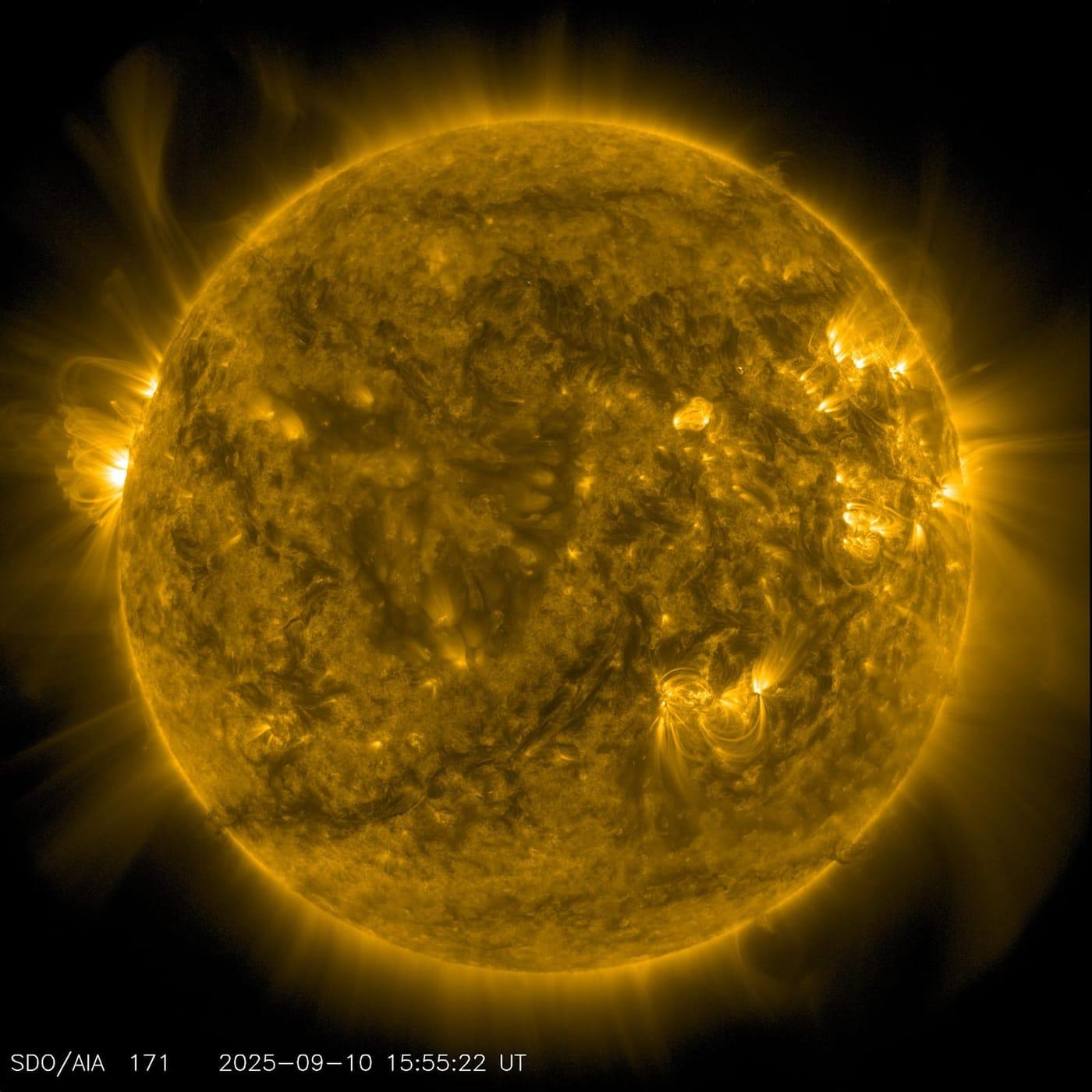
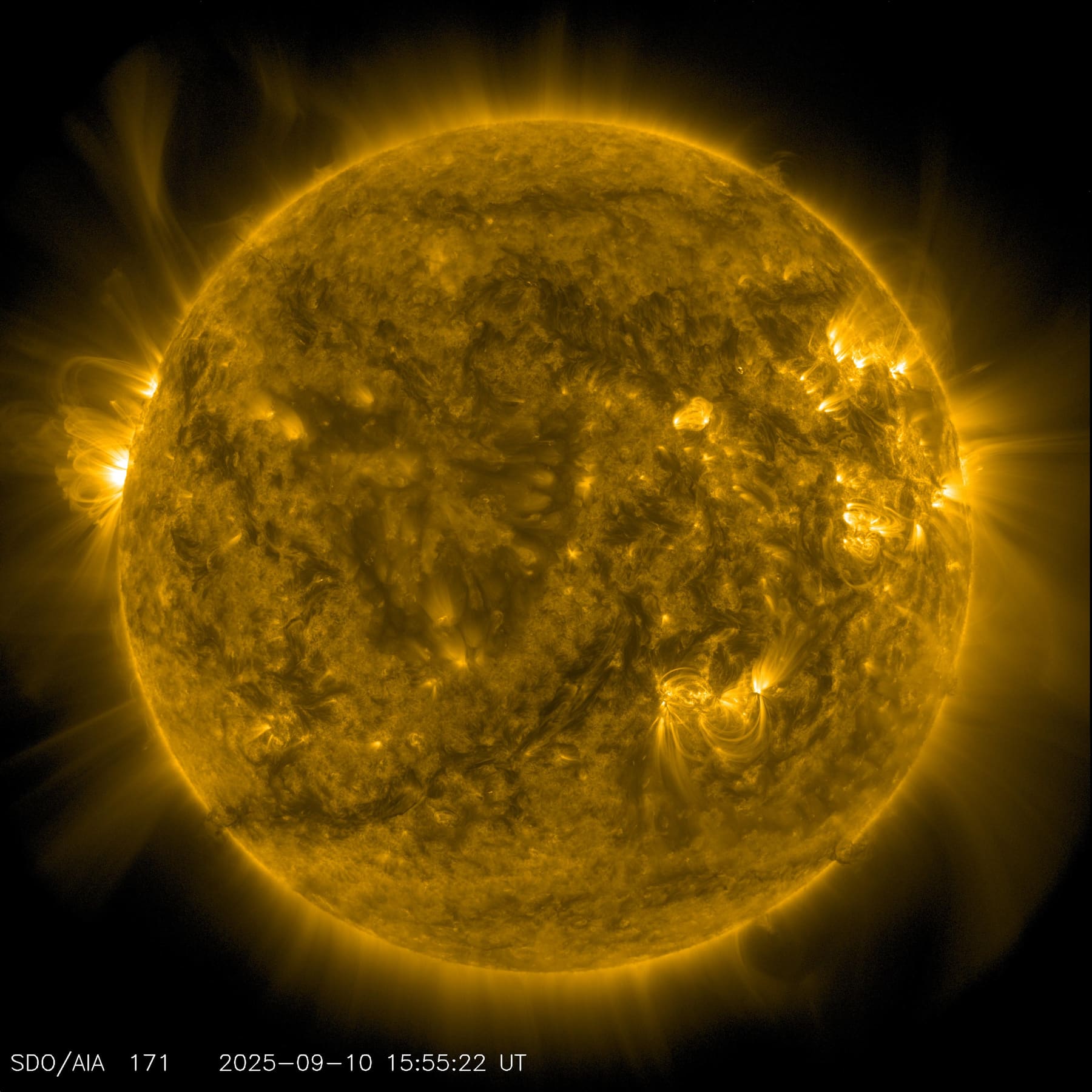
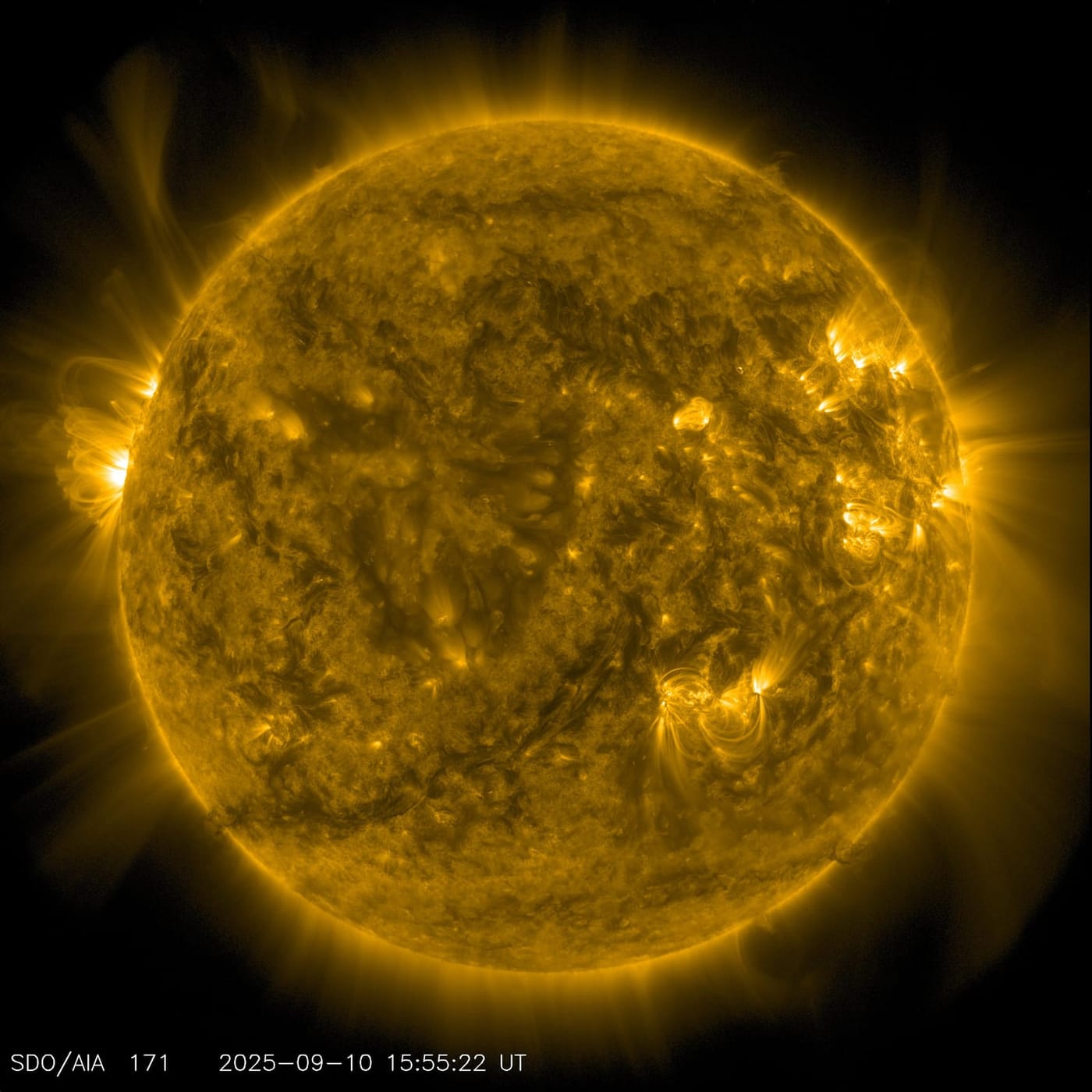
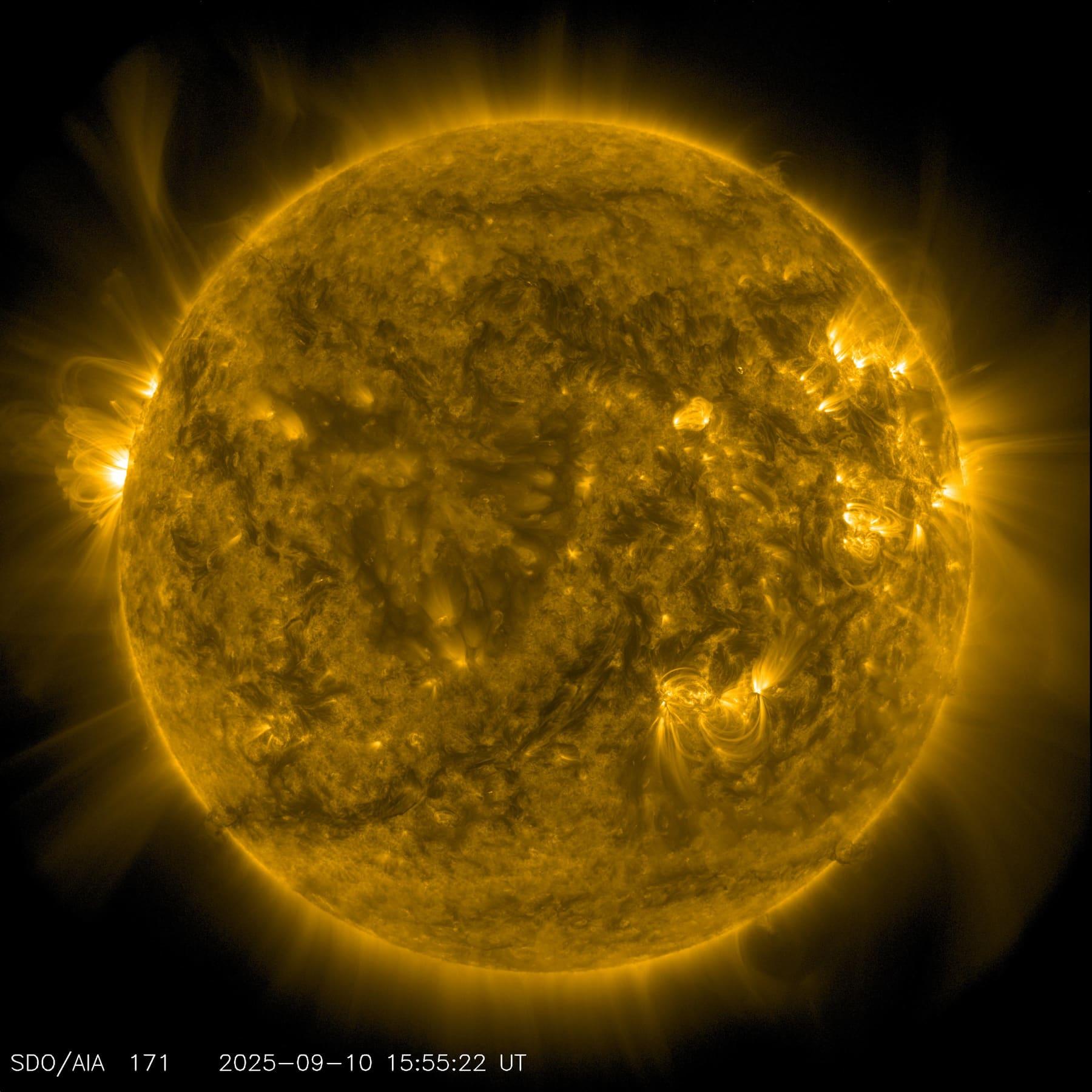
The active Sun in extreme ultraviolet, showing hot plasma tracing magnetic loops above the surface.
The continuous stream of charged particles — mostly protons and electrons — that flows outward from the Sun's corona at hundreds of kilometres per second, filling the Solar System and shaping planetary magnetospheres.
A sudden, intense burst of radiation from the Sun's surface, released when magnetic energy in the corona is explosively reconfigured. The X-rays arrive in minutes and can ionise Earth's upper atmosphere, causing radio blackouts.
An enormous eruption of magnetised plasma from the Sun's corona, launching billions of tonnes of material into space. When aimed at Earth, a CME can drive the largest geomagnetic storms one to three days later.
The vast bubble of solar wind and magnetic field that surrounds the entire Solar System, carving out a cavity in the surrounding interstellar medium and shielding the planets from a fraction of the galactic cosmic rays.
The Parker Solar Probe is the fastest human-made object, reaching speeds of hundreds of thousands of kilometres per hour as the Sun's gravity accelerates it through its closest approaches.
Reading the Sun's interior from the oscillations that ripple across its surface, as seismologists read the Earth from earthquakes. Helioseismology has mapped the Sun's internal rotation and the depth of its convection zone.
The roughly eleven-year rise and fall of the Sun's activity, traced by the number of sunspots from solar minimum to solar maximum and back. Its underlying magnetic cycle takes about twenty-two years, as the Sun's polarity flips and returns. Activity — flares, CMEs, and storms — peaks near solar maximum.
Dark, cooler patches on the Sun's visible surface where intense magnetic fields suppress the flow of heat from below. Their number rises and falls with the solar cycle, and they mark the magnetically active regions from which flares and CMEs erupt.
Areas of strong, complex magnetic field on the Sun, usually marked by sunspots, where magnetic energy builds up and is released. Active regions are the launch sites of the largest solar flares and coronal mass ejections, and are watched closely for space-weather forecasting.
Regions of the Sun's corona where the magnetic field opens out into space rather than looping back, appearing dark in X-ray and ultraviolet images. They are the source of the fast solar wind, and the high-speed streams they send out drive recurring geomagnetic activity.
Time kept by the real Sun, as a sundial shows it — noon is the moment the Sun crosses the meridian. Because the Earth's orbit is elliptical and tilted, the Sun runs fast or slow through the year, so clocks keep mean solar time instead, differing by up to about a quarter of an hour.
The long, stable middle age of a star, during which it fuses hydrogen into helium in its core. This is where stars spend most of their lives — the Sun for roughly ten billion years — and a star's mass fixes where it sits along the main sequence, how brightly it burns, and how long it lasts.
A star's rotation and convection together drive a magnetic dynamo, giving rise to starspots, flares, and hot outer atmospheres, often waxing and waning in activity cycles. The Sun is the star whose magnetic activity we can watch in closest detail, but the same physics operates across the cool stars.
The dominant way low-mass stars like the Sun turn hydrogen into helium: through a chain of steps, four protons are fused into a single helium-4 nucleus, releasing energy and neutrinos. It powers the cores of the coolest main-sequence stars, where temperatures are too low for the competing CNO cycle.
The Sun's local patch of the Galaxy — the stars, gas, and structure within a few hundred light-years. It includes the Local Bubble, a cavity of hot, thin gas blown by ancient supernovae, and it is the vantage point from which we map the entire Milky Way, orbiting the Galactic Centre once every roughly 230 million years.
What is worth observing tonight from a given place, drawn together from the platform's computed twilight, Moon, and planet positions. The plan updates with the observer's clock and location, which stay on the device.
The civil, nautical, and astronomical twilight times for a given place and date — when true darkness begins and ends. Computed from the Sun's position.
The innermost region of the Sun, out to about a quarter of its radius, where nuclear fusion powers the star. At roughly 15 million kelvin and immense density, hydrogen fuses to helium mainly through the proton–proton chain, releasing the energy that slowly works its way outward. Almost all of the Sun's luminosity is generated here.
The layer surrounding the core, from about a quarter to seven-tenths of the solar radius, where energy travels outward as radiation. Photons are absorbed and re-emitted so many times that a single packet of energy can take on the order of a hundred thousand years to cross it. The plasma here rotates almost as a rigid body.
The thin shear layer near seven-tenths of the solar radius, where the rigidly rotating radiative interior meets the differentially rotating convection zone. This velocity shear is widely thought to be where the Sun's large-scale magnetic field is generated — the seat of the solar dynamo.
The outer third of the solar interior, where energy is carried by convection — hot plasma rises, cools, and sinks, like a pot of boiling water. This churning is visible at the surface as granulation and drives the magnetic activity of the Sun. It sits above the tachocline and below the photosphere.
The visible surface of the Sun — the layer from which sunlight escapes — with an effective temperature near 5,772 kelvin and a thickness of only a few hundred kilometres. Sunspots, granulation, and the limb darkening seen in white-light images all belong to the photosphere. It is the reference surface for the Sun's radius.
The reddish layer of the solar atmosphere just above the photosphere, a few thousand kilometres thick, briefly visible as a rosy rim at the start and end of a total eclipse. Its temperature rises with height, and it is threaded by spicules, filaments, and plages. Above it lies the thin transition region.
The thin, irregular layer between the chromosphere and the corona where the temperature climbs steeply — from around ten thousand to a million kelvin over only a few hundred kilometres. It radiates mostly in the extreme ultraviolet and is central to the still-open question of how the corona is heated.
The Sun's outermost atmosphere — a tenuous, million-degree plasma extending millions of kilometres into space, visible to the eye only during a total solar eclipse or with a coronagraph. Far hotter than the surface beneath it, it is shaped by magnetic fields into loops, holes, and streamers, and it continually expands outward as the solar wind.
The mottled, cellular pattern covering the photosphere — the tops of convection cells about a thousand kilometres across, each lasting only minutes. Bright centres are hot plasma rising, dark lanes are cooler plasma sinking. Granulation is the direct visible signature of the convection zone beneath.
A larger-scale convective pattern, with cells around thirty thousand kilometres across that persist for roughly a day. Supergranule flows sweep magnetic field to their edges, building the chromospheric network. It was discovered through Doppler measurements of the surface flows.
A large, relatively cool and dense structure of plasma suspended above the solar surface by magnetic fields, extending into the hot corona. Seen at the limb against the dark sky it appears as a bright arch; quiescent prominences can last for months, while eruptive ones can launch a coronal mass ejection.
The same structure as a prominence, but seen against the bright solar disk rather than at the limb, where it appears as a dark, thread-like channel. A filament is cool plasma along a magnetic boundary; its sudden eruption is a common trigger of a coronal mass ejection.
A bright region of the chromosphere associated with an active region, where concentrated magnetic field heats the plasma above a group of sunspots. Plages are conspicuous in the light of hydrogen and calcium and mark magnetically active areas even as the sunspots themselves come and go.
A short-lived jet of plasma, a few hundred kilometres across, that shoots up from the chromosphere at tens of kilometres per second and falls back within minutes. Millions cover the Sun at any moment, giving the chromospheric limb a grassy appearance; they may contribute to the mass and energy budget of the corona.
An arch of hot, glowing plasma tracing a magnetic field line rooted in the photosphere, the basic building block of the closed corona above active regions. Coronal loops shine brightly in the extreme ultraviolet and X-rays and are central to studies of how the corona is structured and heated.
A large, pointed structure in the corona, seen in eclipse and coronagraph images as bright rays extending outward above the streamer belt. Helmet streamers cap closed magnetic regions and are the source of the slow solar wind; their shape changes over the solar cycle.
A thin, ray-like structure of denser plasma rooted in the Sun's polar regions and extending into a polar coronal hole. Plumes trace open magnetic field lines from which fast solar wind flows, and appear as delicate streaks in images of the poles.
The mechanism that generates and regenerates the Sun's magnetic field, converting the energy of plasma motions — differential rotation and convection — into magnetic energy. The dynamo drives the roughly eleven-year sunspot cycle and the reversal of the Sun's polarity; the details, especially the role of the tachocline, remain an active research problem.
The process by which oppositely directed magnetic field lines break and reconnect, converting stored magnetic energy explosively into heat, light, and fast particles. Reconnection powers solar flares and helps launch coronal mass ejections, and is a fundamental plasma process seen throughout the Universe.
The Sun does not rotate as a solid body: its equator completes a turn in about twenty-five days while the polar regions take around thirty-five. This shearing of the plasma winds up the magnetic field and is a key ingredient of the solar dynamo. It is measured from tracking sunspots and from helioseismology.
One of the central open questions in solar physics: why the corona, at a million or more kelvin, is hundreds of times hotter than the photosphere below it. Leading candidate mechanisms include heating by many tiny reconnection events (nanoflares) and by magnetic waves; missions such as Parker Solar Probe and Solar Orbiter are testing them. No single answer is yet established.
A proposed solution to the coronal heating problem, put forward by Eugene Parker: the corona is heated by a vast number of tiny reconnection events — nanoflares — each far too small to see on its own, but collectively enough to keep the corona hot. It is one of several candidate mechanisms still being tested against observations.
A plot of the latitudes at which sunspots appear over time, first drawn by the Maunders. Across each roughly eleven-year cycle, spots emerge first at mid-latitudes and then closer to the equator, so successive cycles trace wing-shaped patterns. It is the clearest visual summary of the solar activity cycle.
A roughly seventy-year span in the seventeenth and early eighteenth centuries when sunspots almost vanished from the record. It overlapped part of the cooler period known as the Little Ice Age, though the size of any climate link is debated. It is the archetype of a grand solar minimum.
A period of low but not absent solar activity around the turn of the nineteenth century, less deep than the Maunder Minimum. Like other grand minima it is reconstructed from sunspot counts and from cosmogenic isotopes recorded in ice cores and tree rings.
The total energy the Sun radiates varies slightly over the activity cycle — by about a tenth of a percent between solar maximum and minimum — as dark sunspots and bright faculae come and go. Measured continuously from space since the late 1970s, these variations are a key input to studies of the Sun's influence on climate.
The steady, high-speed stream of the solar wind — around seven to eight hundred kilometres per second — that flows out along open magnetic field lines from coronal holes, especially over the poles at solar minimum. It is smoother and less dense than the slow wind.
The denser, more variable component of the solar wind — around three to five hundred kilometres per second — associated with the streamer belt near the solar equator. Its exact sources and release mechanisms are still being pinned down by close-in missions.
The spiral shape the Sun's magnetic field takes as it is carried outward by the solar wind while the Sun rotates, like water from a spinning sprinkler. Predicted by Eugene Parker in 1958 and since confirmed by spacecraft, the Parker spiral sets the geometry of the interplanetary magnetic field and how solar storms reach the planets.
The boundary where the supersonic solar wind abruptly slows as it runs into the pressure of the interstellar medium, roughly ninety astronomical units from the Sun. Voyager 1 crossed it in 2004 and Voyager 2 in 2007 — the first direct measurements of this shock.
The turbulent outer region of the heliosphere, between the termination shock and the heliopause, where the slowed solar wind piles up and is deflected by the interstellar medium. Both Voyager spacecraft spent years traversing it before reaching interstellar space.
The disturbance ahead of the heliosphere as it moves through the surrounding interstellar cloud. Earlier work expected a sharp bow shock, but measurements from IBEX and the Voyagers suggest the Sun moves too slowly through the local medium for a strong shock — a gentler bow wave instead. The exact nature of the boundary is still being studied.
The quantum phenomenon in which a neutrino changes flavour — electron, muon, or tau — as it travels. Its discovery proved that neutrinos have a small mass, resolved the decades-old 'solar neutrino problem' of the Sun apparently producing too few, and was recognised with the 2015 Nobel Prize in Physics.
Einstein's result that mass and energy are two forms of the same thing, related by the speed of light squared. It is the accounting behind starlight: fusing hydrogen into helium in the Sun's core converts about four million tonnes of mass into energy every second, and it governs the annihilation of matter with antimatter.
Red giant in Aquarius, about 233 light-years from Earth.
Subgiant in Canis Minor, about 316 light-years from Earth.
Subgiant in Cassiopeia, about 1,129 light-years from Earth.
Main-sequence star in Centaurus, about 63.3 light-years from Earth.
Main-sequence star in Eridanus, about 46.4 light-years from Earth.
Star in Gemini, about 155 light-years from Earth.
Facts on this topic will be cited from these primary and reference sources.
Mission data, planetary science, space telescopes, and public-domain imagery.
Most NASA-produced imagery is in the public domain; individual items are checked for usage terms before publication.