Astronomy · Space Missions
Parker Solar Probe
The mission flying through the Sun's outer atmosphere.
- Agency
- NASA
- Target
- The Sun
- Distinction
- Closest spacecraft to the Sun
- Goal
- Understand the corona and solar wind
NASA/Kennedy · NASA media (public domain)
Gallery
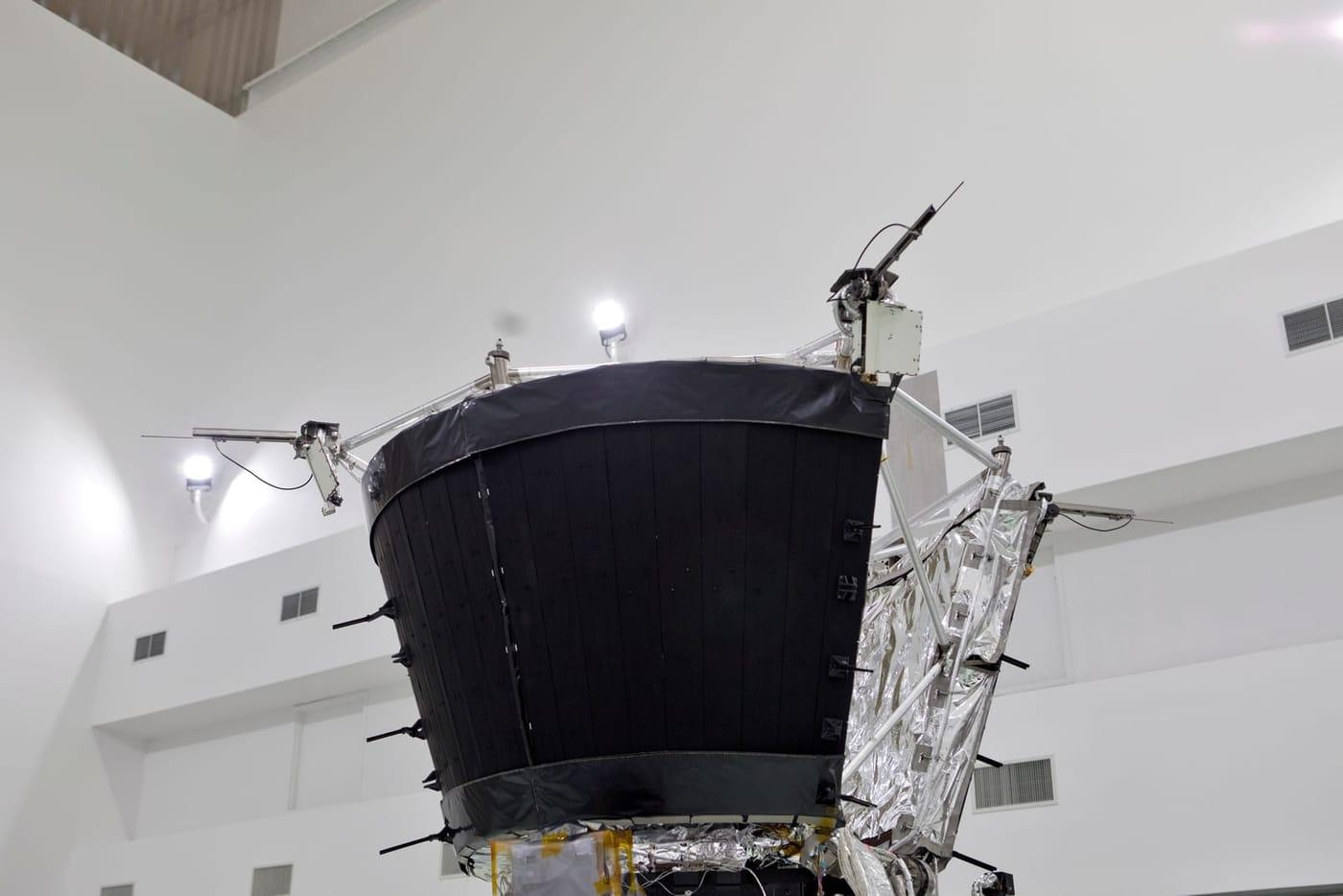
Parker Solar Probe Antenna Deployment
Antenna's on NASA's Parker Solar Probe are deployed for testing at the Astrotech processing facility in Titusville, Florida, near NASA's Kennedy Space Center on Thursday, April 19, 2018.
2018
NASA/Kennedy · NASA media (public domain)
Touching the Sun
Parker Solar Probe is a NASA mission designed to fly closer to the Sun than any spacecraft before it, repeatedly diving through the corona — the Sun's outer atmosphere — protected by a heat shield.
Surviving the heat
To withstand the intense heat and light, the probe hides its instruments behind a thick shield and uses its speed to make brief, close passes before swinging back out.
Why it matters
By sampling the corona directly, Parker Solar Probe helps answer long-standing questions about why the corona is so hot and how the solar wind — the stream of particles that affects the whole Solar System — is produced.
Knowledge connections
How this connects across Asteria Star — scientific, cultural, and astrological links are kept separate.
Scientific connections
- Associated withFastest Human-Made Object
- Associated withCoronal Holes
- Associated withThe Coronal Heating Problem
- Associated withThe Parker Spiral
Observational connections
- ObservesSolar Wind
Mission connections
- Operated byNASA
- Mission targetThe Sun
- Launched byDelta IV Heavy
- Launched fromCape Canaveral Space Force Station
- Tracked byDeep Space Network (DSN)