Astronomy · Space Missions
New Horizons
The first spacecraft to fly past Pluto.
- Agency
- NASA
- Launched
- 2006
- Pluto flyby
- 2015
- Then
- Flew past a Kuiper Belt object
NASA/Johns Hopkins University Applied Physics Laboratory/Southwest Research Institute · NASA media (public domain)
Gallery
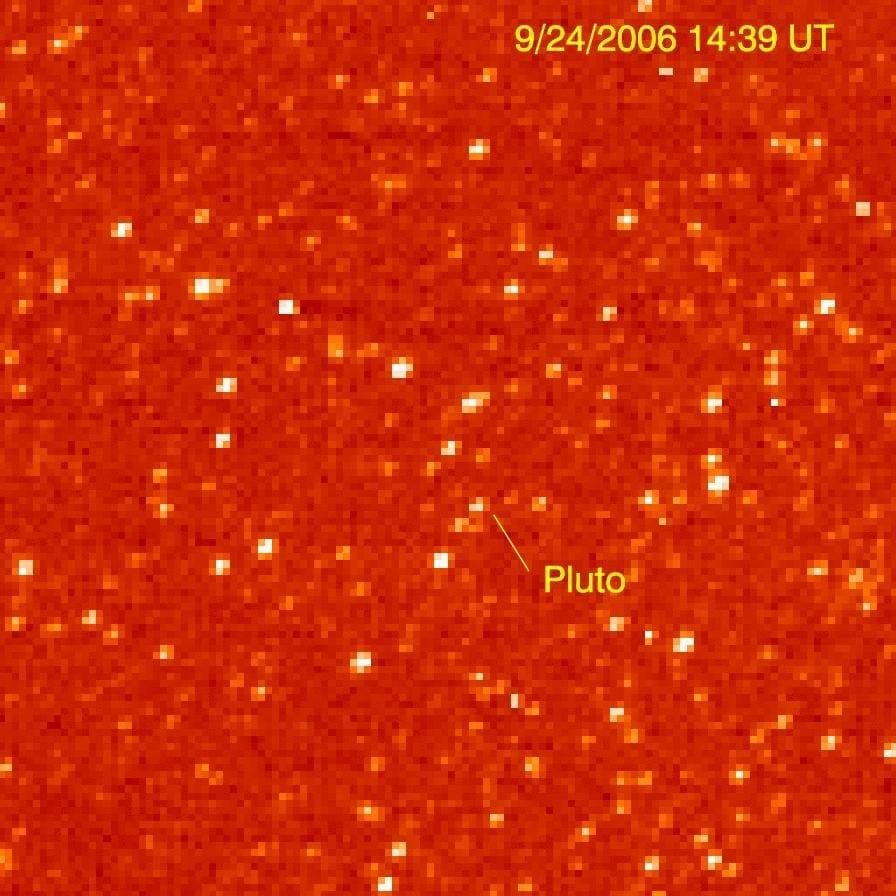
New Horizons Tracks an Asteroid
The two pots in this image are a composite of two images of asteroid 2002 JF56 taken on June 11 and June 12, 2006, with the Multispectral Visible Imaging Camera component of the New Horizons Ralph imager.
2007
NASA/Johns Hopkins University Applied Physics Laboratory/Southwest Research Institute · NASA media (public domain)
Racing to Pluto
New Horizons launched in 2006 on a fast trajectory to the outer Solar System. In 2015 it made the first close flyby of Pluto, transforming our view of the dwarf planet.
What it found
The flyby revealed mountains of water ice, smooth nitrogen-ice plains, and a thin atmosphere, showing that even a small, distant world can be surprisingly active.
Deeper into the belt
After Pluto, New Horizons continued outward to fly past a small, ancient Kuiper Belt object, providing the closest look yet at one of these primitive building blocks of the Solar System.
Knowledge connections
How this connects across Asteria Star — scientific, cultural, and astrological links are kept separate.
Scientific connections
- Associated withStar Tracker
- Associated withSputnik Planitia
- Associated withTenzing Montes
- Associated withNew Horizons Flies Past Pluto
Mission connections
- Operated byNASA
- Mission targetPluto
- Part of programNew Frontiers program
- Launched byAtlas V
- Launched fromCape Canaveral Space Force Station
- VisitedPluto
- Tracked byDeep Space Network (DSN)
Related
- Carries instrumentLORRI (Long Range Reconnaissance Imager)
- Carries instrumentAlice (New Horizons UV Spectrometer)