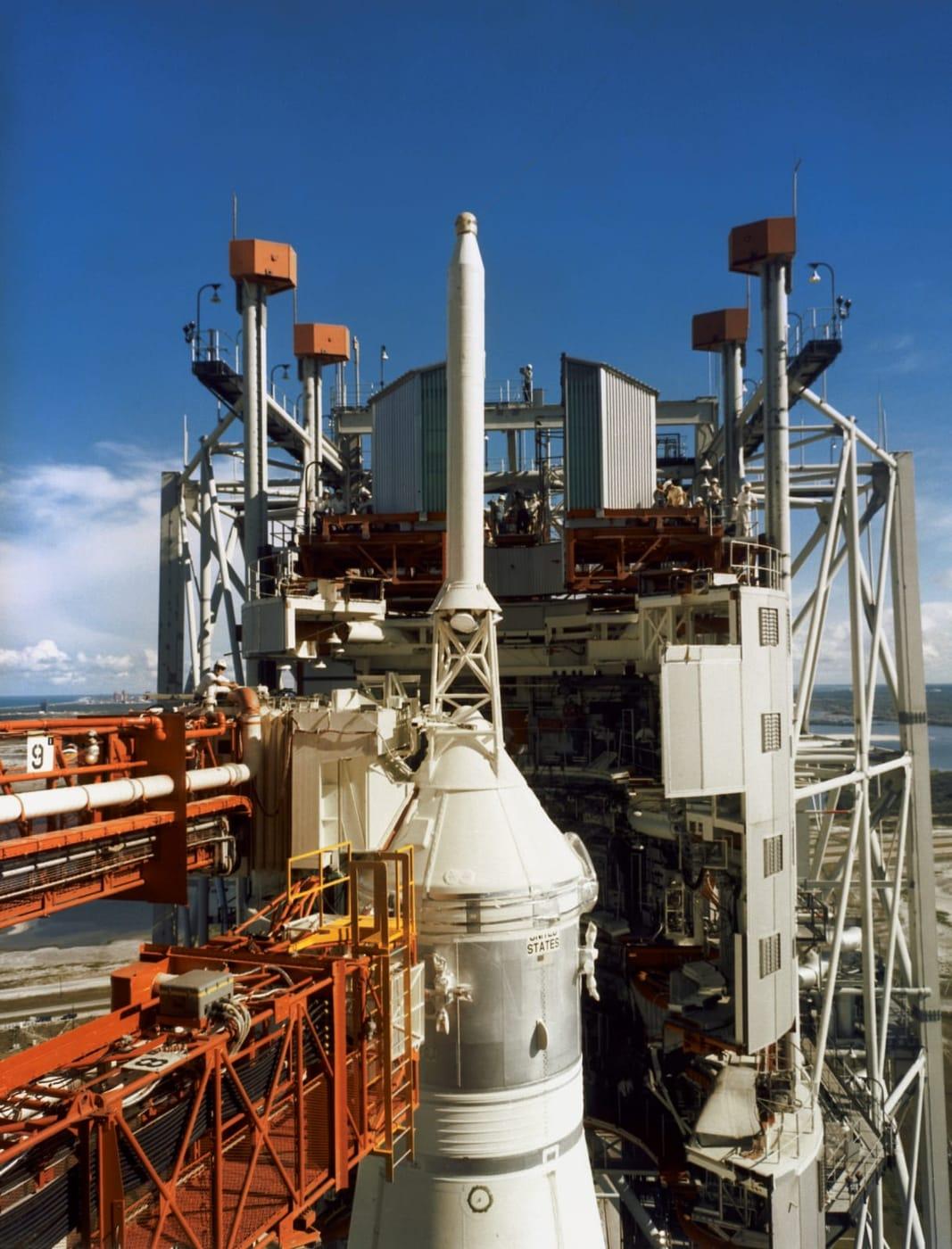
Astronomy · Space Missions
Apollo 11
The first crewed landing on the Moon, in 1969.
- Agency
- NASA
- Year
- 1969
- Crew
- Armstrong, Aldrin, and Collins
- Achievement
- First humans to walk on the Moon
NASA/Johnson · NASA media (public domain)
Gallery
Apollo 11 50th Anniversary Celebration
A visitor learns about circuits at the Apollo 11 50th Anniversary celebration on the National Mall, Friday, July 19, 2019 in Washington.
2019
NASA · NASA media (public domain)
The first Moon landing
Apollo 11 was the NASA mission that, in July 1969, carried the first humans to the surface of the Moon. It was the culmination of the Apollo program's goal of a crewed lunar landing.
The crew
Neil Armstrong and Buzz Aldrin descended to the surface in the lunar module and walked on the Moon, while Michael Collins remained in orbit aboard the command module. The astronauts collected samples and deployed experiments before returning safely to Earth.
Its legacy
Apollo 11 demonstrated that humans could travel to another world and return, and it remains one of the most significant achievements in the history of exploration.
Knowledge connections
How this connects across Asteria Star — scientific, cultural, and astrological links are kept separate.
Scientific connections
- Associated withSaturn V
- Associated withApollo 11 Lands the First Humans on the Moon
- Associated withFirst Humans on the Moon
Mission connections
- Operated byNASA
- Mission targetThe Moon
- Part of programApollo program
- Launched bySaturn V
- Launched fromKennedy Space Center
- Mission includesNeil Armstrong
- Mission includesBuzz Aldrin
- Mission includesMichael Collins
- Mission includesApollo 11 lunar EVA
Timeline
July 16, 1969
Launch
Apollo 11 lifts off atop a Saturn V rocket from Kennedy Space Center.
July 20, 1969
Lunar landing
The lunar module Eagle lands; Armstrong and Aldrin become the first humans to walk on the Moon.
July 24, 1969
Return to Earth
The crew splashes down safely in the Pacific Ocean.
Related entries
Astronomy
Voyager 1
The most distant human-made object, now in interstellar space.
Astronomy
Earth
The third planet — and the only known home of life.
Astronomy
Voyager 2
The only probe to visit all four giant planets.
Astronomy
James Webb Space Telescope
The launch and operation of the great infrared observatory.