Astronomy · Space Missions
Voyager 1
The most distant human-made object, now in interstellar space.
- Agency
- NASA
- Launched
- 1977
- Explored
- Jupiter and Saturn
- Status
- In interstellar space — most distant human-made object
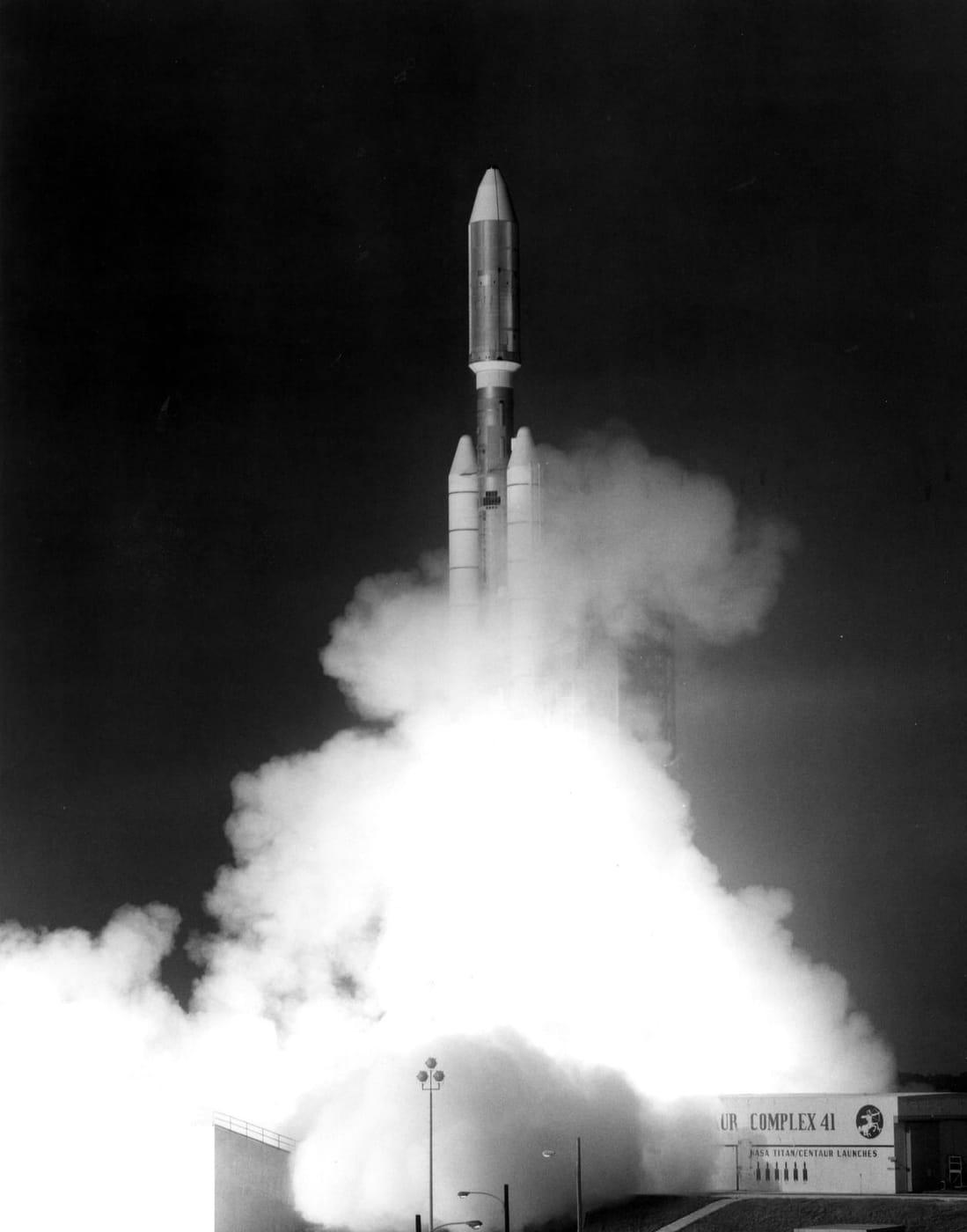
NASA/KSC · NASA media (public domain)
Gallery
Changes on Io around Volund between Voyager 1 and Galileo Second Orbit
1997
NASA/JPL/University of Arizona · NASA media (public domain)
A grand tour of the giants
Voyager 1 launched in 1977 and flew past Jupiter and Saturn, sending back detailed images of the planets, their rings, and their moons that reshaped planetary science.
Into interstellar space
After its planetary encounters, Voyager 1 continued outward. It eventually crossed beyond the heliosphere — the bubble of solar influence — into interstellar space, becoming the most distant human-made object.
The Golden Record
Voyager 1 carries the Golden Record, a phonograph disc of sounds and images chosen to represent life and culture on Earth, intended as a message to any future finder.
Knowledge connections
How this connects across Asteria Star — scientific, cultural, and astrological links are kept separate.
Scientific connections
- Associated withHigh-Gain Antenna (Spacecraft)
- Associated withHeliopause
- Associated withLaunch of the Voyagers
- Associated withVoyager 1 Enters Interstellar Space
- Associated withMost Distant Human-Made Object
- Associated withFirst Object to Reach Interstellar Space
- Associated withLongest-Operating Interplanetary Spacecraft
- Associated withThe Termination Shock
- Associated withThe Heliosheath
Observational connections
- CapturedPale Blue Dot
- CapturedThe Solar System Family Portrait
Mission connections
- Operated byNASA
- Mission targetSaturn
- Operated byNASA Jet Propulsion LaboratoryManaged by NASA's Jet Propulsion Laboratory.
- Part of programVoyager program
- Mission targetJupiter
- Tracked byDeep Space Network (DSN)
Related
- Carries instrumentVoyager Imaging Science Subsystem
- Carries instrumentVoyager Cosmic Ray Subsystem (CRS)