Astronomy · Planets
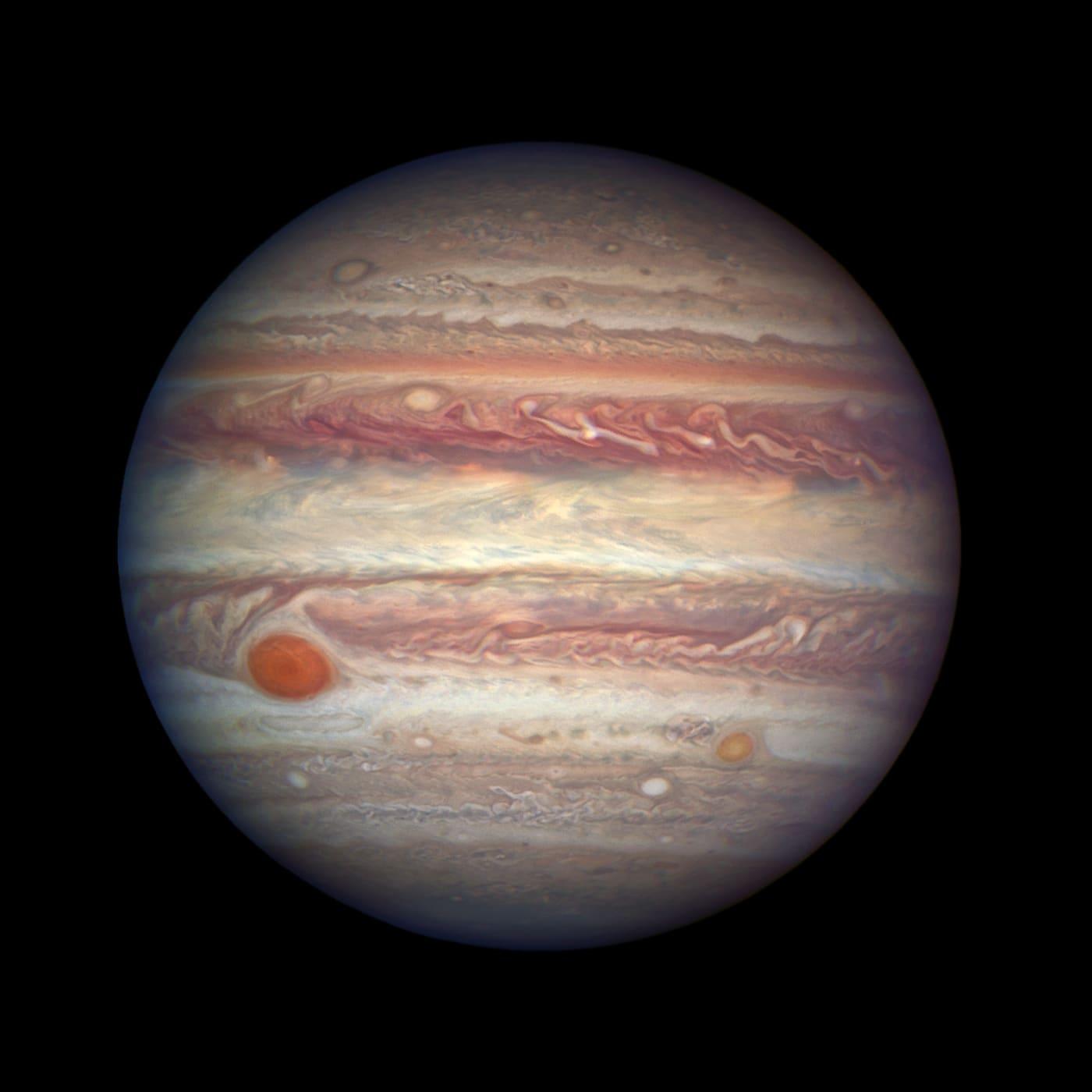
Jupiter
The largest planet — a banded gas giant.
- Order from Sun
- Fifth planet
- Type
- Gas giant
- Size
- Largest planet in the Solar System
- Famous feature
- The Great Red Spot, a long-lived storm
NASA Goddard · NASA media (public domain)
Gallery
Jupiter Plume
1999
NASA/JPL · NASA media (public domain)
King of the planets
Jupiter is the largest planet in the Solar System — a gas giant more massive than all the other planets combined. It has no solid surface; its visible 'surface' is the top of a deep, turbulent atmosphere.
Bands and the Great Red Spot
Jupiter's atmosphere is organized into colorful bands of clouds driven by powerful winds. Its most famous feature is the Great Red Spot, an enormous storm that has persisted for a very long time.
A system of moons
Jupiter is orbited by a large number of moons. The four largest — Io, Europa, Ganymede, and Callisto — were discovered by Galileo and are called the Galilean moons; Europa in particular is studied for its subsurface ocean.
Knowledge connections
How this connects across Asteria Star — scientific, cultural, and astrological links are kept separate.
Scientific connections
- Part ofSolar System
- Parent ofIoOne of the four Galilean moons.
- Parent ofEuropaOne of the four Galilean moons.
- Parent ofGanymedeOne of the four Galilean moons.
- Parent ofCallistoOne of the four Galilean moons.
- Parent ofAmalthea
- Associated with3:2 resonance with Jupiter
- Associated with1:1 resonance with Jupiter
- Associated withComet Shoemaker–Levy 9
- Associated withGalileo Arrives at Jupiter
- Associated withAtmospheric Circulation
- Associated withSolar System Explorer
- Associated withPlanet Explorer
- Associated withPlanet Planner
- Associated withThe Solar System in 3D
Observational connections
- Observed byGalileo Galilei
- Observed byGiovanni Cassini
Mission connections
- Target ofJuno
- TargetsGalileo
- Target ofPioneer 10
- Target ofPioneer 11
- Target ofVoyager 1
- Target ofVoyager 2
- Target ofGalileo
- Target ofJUICE (Jupiter Icy Moons Explorer)
- Target ofEuropa Clipper
Discovery connections
- Depicted inJupiter (James Webb Space Telescope)
Related
- Has featureGreat Red Spot
- Related toThe Galilean Moons of Jupiter
Related entries
Related missions
Space mission
Europa Clipper
Europa Clipper will make dozens of flybys of Jupiter's moon Europa to assess its habitability.
Space mission
Galileo
Jupiter orbiter · NASA · launched 1989.
Space mission
JUICE (Jupiter Icy Moons Explorer)
JUICE is ESA's mission to study Jupiter's icy moons Ganymede, Callisto, and Europa.
Space mission
Juno
Juno is a NASA space probe launched in 2011 that entered orbit around Jupiter in 2016 to study the planet's composition, gravity, and magnetic field.
Space mission
Pioneer 10
Pioneer 10 was the first spacecraft to traverse the asteroid belt and fly past Jupiter.
Space mission
Pioneer 11
Pioneer 11 flew past Jupiter and became the first spacecraft to encounter Saturn.
Space mission
Voyager 1
Voyager 1 is a NASA space probe launched in 1977 that explored Jupiter and Saturn and has since become the most distant human-made object, traveling in interstellar space.
Space mission
Voyager 2
Voyager 2 is a NASA space probe launched in 1977 and the only spacecraft to have flown past all four giant planets: Jupiter, Saturn, Uranus, and Neptune.