Astronomy · Planets
Mercury
The smallest planet, closest to the Sun.
- Order from Sun
- First planet
- Type
- Terrestrial (rocky) planet
- Size
- Smallest planet in the Solar System
- Atmosphere
- Only an extremely thin exosphere
NASA/Johns Hopkins University Applied Physics Laboratory/Carnegie Institution of Washington · NASA media (public domain)
Gallery
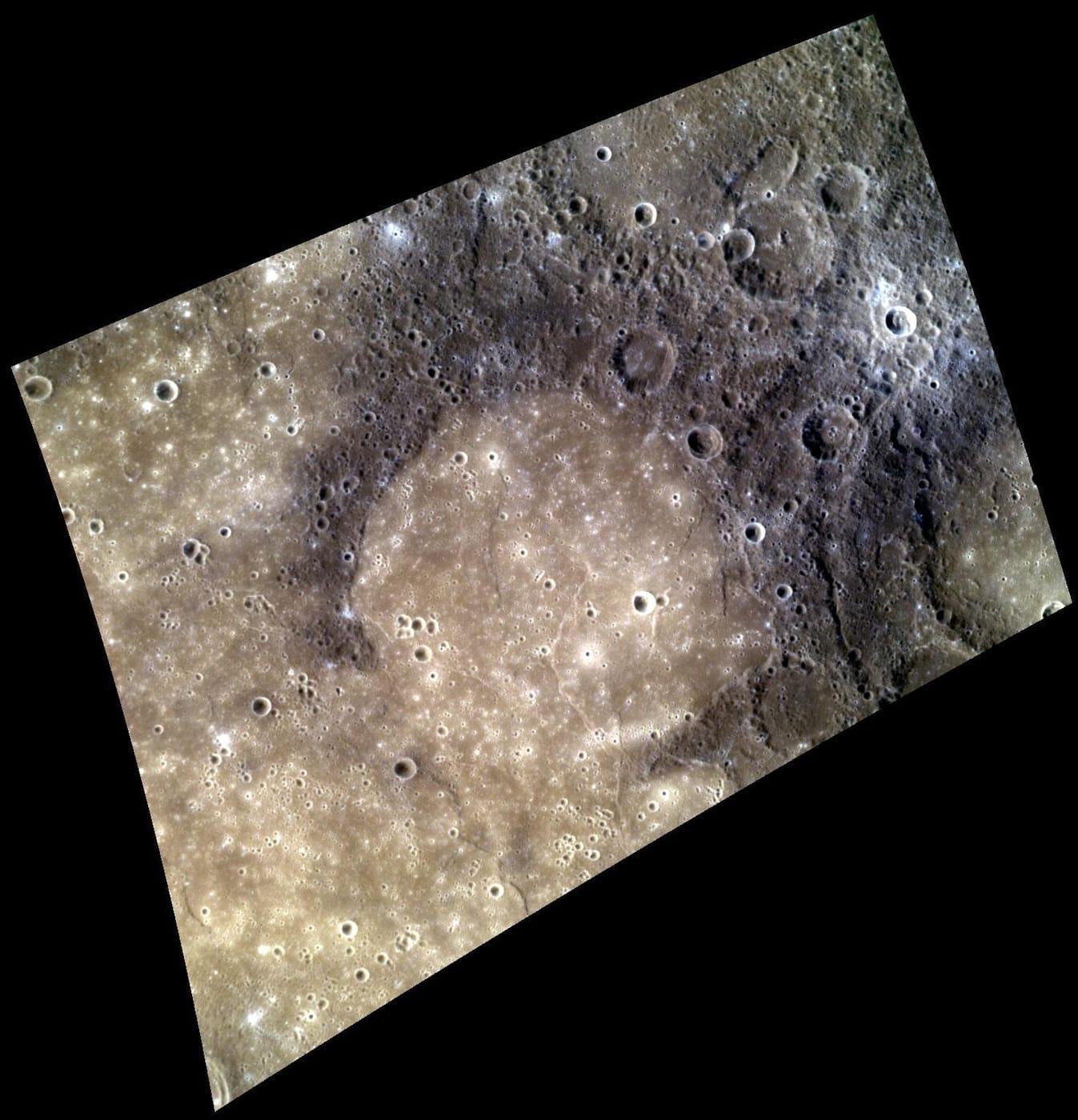
Mercury in Bronze
2014
NASA/Johns Hopkins University Applied Physics Laboratory/Carnegie Institution of Washington · NASA media (public domain)
The innermost planet
Mercury orbits closer to the Sun than any other planet and is the smallest of the eight. It is a rocky, terrestrial world with a large metallic core relative to its size.
A world of extremes
With essentially no atmosphere to trap or redistribute heat, Mercury experiences enormous differences between its sunlit and night sides. Its cratered, Moon-like surface preserves the scars of ancient impacts.
Hard to observe
Because it never strays far from the Sun in our sky, Mercury is best seen low on the horizon during twilight, and only briefly. Spacecraft have provided most of our detailed knowledge of it.
Knowledge connections
How this connects across Asteria Star — scientific, cultural, and astrological links are kept separate.
Scientific connections
- Part ofSolar System
- Associated withCore
- Associated withImpact Cratering History
- Associated withSpin–Orbit Coupling
Mission connections
- TargetsMESSENGER
- TargetsMariner 10
- Target ofMariner 10
- Target ofMESSENGER
- Target ofBepiColombo
Related
- Has featureCaloris Planitia
- Has featureDiscovery Rupes