Astronomy · Dwarf Planets
Pluto
The most famous dwarf planet, in the Kuiper Belt.
- Location
- Kuiper Belt, beyond Neptune
- Classification
- Reclassified as a dwarf planet in 2006 (IAU)
- Largest moon
- Charon
- Explored by
- NASA's New Horizons (2015 flyby)
NASA/Johns Hopkins University Applied Physics Laboratory/Southwest Research Institute · NASA media (public domain)
Gallery
Faces of Pluto
These images, taken by NASA's New Horizons' Long Range Reconnaissance Imager (LORRI), show four different "faces" of Pluto as it rotates about its axis with a period of 6.4 days.
2015
NASA/Johns Hopkins University Applied Physics Laboratory/Southwest Research Institute · NASA media (public domain)
From planet to dwarf planet
Pluto was discovered in 1930 and long regarded as the ninth planet. In 2006 the International Astronomical Union adopted a formal definition of 'planet'; Pluto did not meet the criterion of clearing its orbital neighborhood and was reclassified as a dwarf planet.
An icy Kuiper Belt world
Pluto orbits in the Kuiper Belt, a region of icy bodies beyond Neptune. It has a thin atmosphere and a system of moons, the largest of which, Charon, is so big relative to Pluto that the two orbit a point between them.
Seen up close
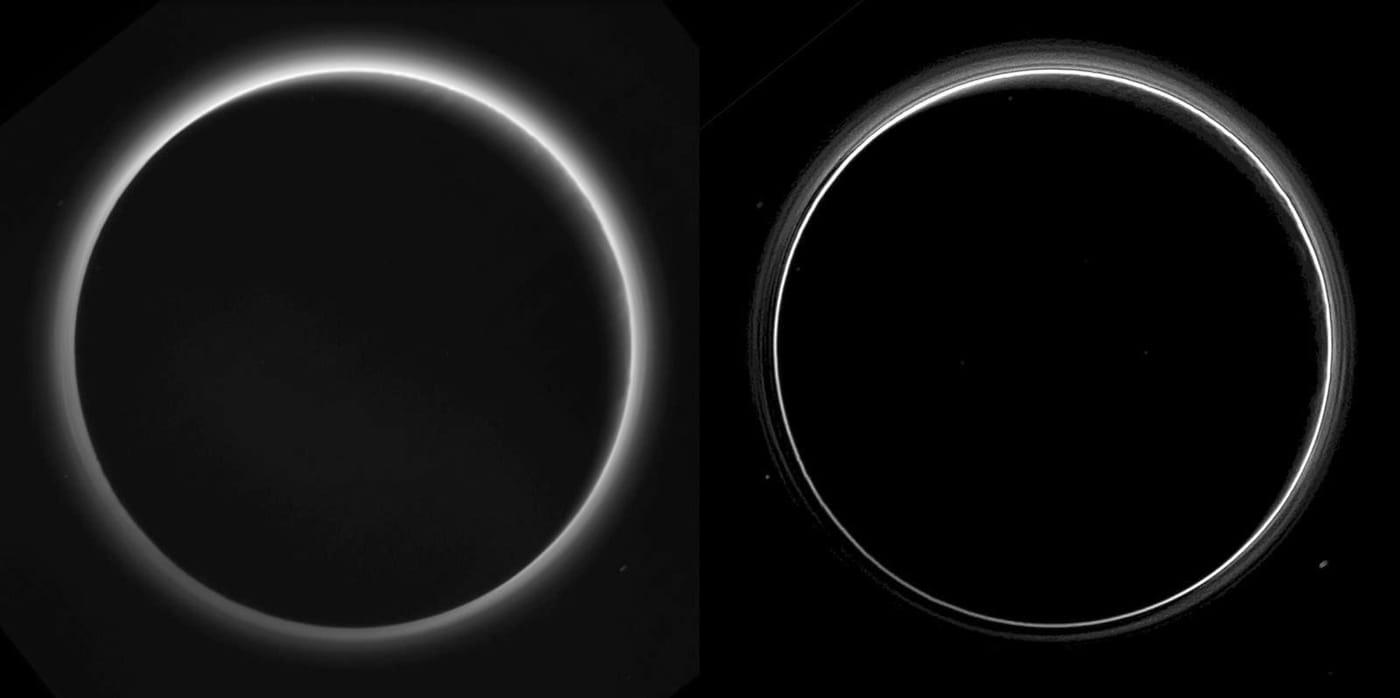
NASA's New Horizons spacecraft flew past Pluto in 2015, transforming it from a blurry dot into a detailed world with mountains of ice, smooth plains, and a famous heart-shaped region.
Knowledge connections
How this connects across Asteria Star — scientific, cultural, and astrological links are kept separate.
Scientific connections
- Part ofSolar System
- Parent ofCharon
- Associated withNew Horizons Flies Past Pluto
Mission connections
- Target ofNew Horizons
- Visited byNew Horizons
Related
- Member of groupKuiper Belt
- In orbital resonance2:3 resonance with Neptune
- Has featureSputnik Planitia
- Has featureTenzing Montes
Related entries
Related missions
You might also explore
- Dwarf planetHaumeaLinked through Solar System
- Dwarf planetMakemakeLinked through Solar System
- Scientific instrumentAlice (New Horizons UV Spectrometer)Linked through New Horizons
- Launch vehicleAtlas VLinked through New Horizons
- Launch siteCape Canaveral Space Force StationLinked through New Horizons
- Tracking networkDeep Space Network (DSN)Linked through New Horizons