Astronomy · Dwarf Planets
Ceres
The largest body in the asteroid belt.
- Location
- Asteroid belt, between Mars and Jupiter
- Distinction
- Largest object in the asteroid belt
- Classification
- The only dwarf planet in the inner Solar System
- Explored by
- NASA's Dawn mission
NASA/JPL-Caltech/UCLA/MPS/DLR/IDA · NASA media (public domain)
Gallery
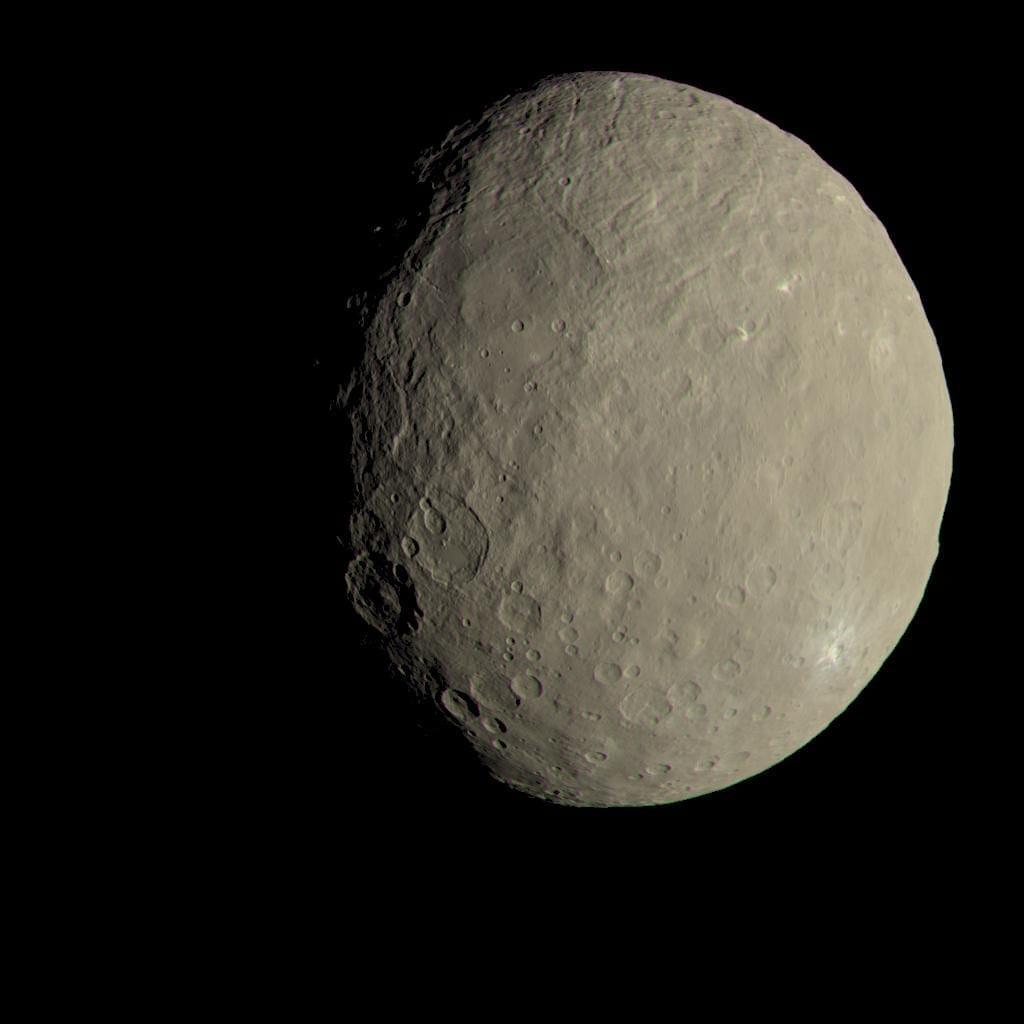
Ceres From Dawn, Processed
This processed image, taken Jan. 13, 2015, shows the dwarf planet Ceres as seen from the Dawn spacecraft. The image hints at craters on the surface of Ceres. Dawn framing camera took this image at 238,000 miles 383,000…
2015
NASA/JPL-Caltech/UCLA/MPS/DLR/IDA · NASA media (public domain)
Belt giant and dwarf planet
Ceres is by far the largest object in the asteroid belt between Mars and Jupiter. It is large enough that its own gravity pulled it into a round shape, which is why it is classified as a dwarf planet rather than an asteroid.
An icy interior
Unlike rocky asteroids, Ceres contains a significant amount of water ice and may have once held subsurface brine. This makes it an interesting target for understanding water in the early Solar System.
The Dawn mission
NASA's Dawn spacecraft orbited Ceres and mapped its surface in detail, finding striking bright spots — concentrations of salts — and a solitary tall mountain, hinting at past geological activity.
Knowledge connections
How this connects across Asteria Star — scientific, cultural, and astrological links are kept separate.
Scientific connections
- Part ofSolar System
Related
- Member of groupMain Asteroid Belt
- Has featureOccator Crater
- Has featureAhuna Mons