Astronomy · Space Telescopes
James Webb Space Telescope
The great infrared observatory of the modern era.
- Type
- Infrared telescope
- Mirror
- Large segmented, gold-coated primary mirror
- Location
- Near the Sun–Earth L2 point
- Operators
- NASA, ESA, and CSA
NASA/Goddard Space Flight Center · NASA media (public domain)
Gallery
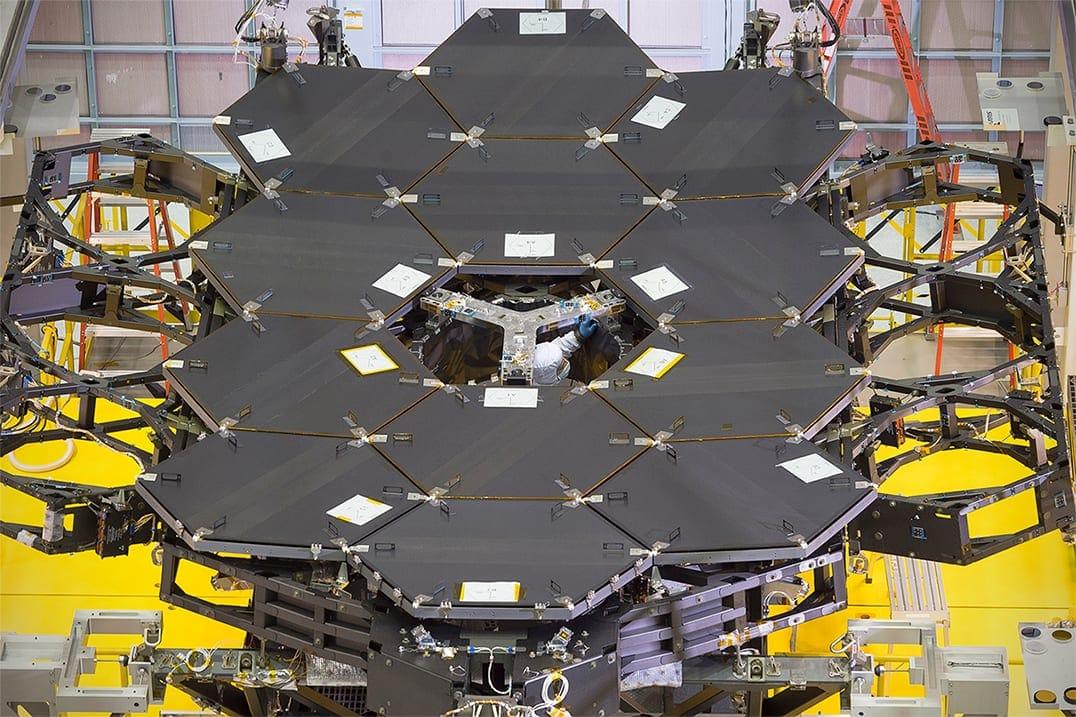
By the Dozen: NASA's James Webb Space Telescope Mirrors
A view of the one dozen (out of 18) flight mirror segments that make up the primary mirror on NASA's James Webb Space Telescope have been installed at NASA's Goddard Space Flight Center.
2016
NASA/Goddard Space Flight Center · NASA media (public domain)
An infrared eye
The James Webb Space Telescope is designed to observe infrared light. Because the expansion of the universe stretches light from the most distant galaxies into the infrared, Webb can see objects from the universe's early history.
Built to stay cold
Webb uses a large segmented primary mirror to gather faint light and a tennis-court-sized sunshield to block the Sun's heat. Operating far from Earth and kept very cold, it can detect faint infrared signals.
Seeing through dust
Infrared light passes through clouds of dust that block visible light, so Webb can look inside stellar nurseries and study disks where planets form, as well as the atmospheres of exoplanets. Its launch and journey are covered under Space Missions.
Knowledge connections
How this connects across Asteria Star — scientific, cultural, and astrological links are kept separate.
Scientific connections
- Associated withLaunch of the James Webb Space Telescope
- Associated withMAST
- Associated withASDF
- Associated withWater
- Associated withPolycyclic Aromatic Hydrocarbons
- Associated withLagrange Points
- Associated withJWST Target Overlay
- Associated withTransmission Spectroscopy
- Associated withEmission Spectroscopy
- Associated withPhase Curves
Observational connections
- StudiesEagle NebulaWebb re-imaged the Pillars of Creation in infrared.
- StudiesOrion Nebula
- ObservesNear-infrared
- ObservesInfrared
- Has instrumentNIRISS
- MeasuresCosmic Dawn & the First Stars
- MeasuresReionization
- CapturedWebb's First Deep Field (SMACS 0723)
- CapturedCosmic Cliffs in the Carina Nebula
- CapturedThe Southern Ring Nebula
- CapturedStephan's Quintet
- CapturedJupiter (James Webb Space Telescope)
Mission connections
- Operated byNASA
- Operated byESA
- Operated byCanadian Space Agency (CSA)
- Launched byAriane 5
- Launched fromGuiana Space Centre
- Operated bySpace Telescope Science Institute
- Tracked byDeep Space Network (DSN)
Discovery connections
- DiscoveredCWISEP J193518.59-154620.3 b
- DiscoveredTWA 7 b
- DiscoveredWISE J033605.05-014350.4 b
- DiscoveredJWST's First Science Images
Related
- Carries instrumentNIRCam
- Carries instrumentMIRI
- Carries instrumentNIRSpec
- Related toJWST's First Science Images
Related entries
Astronomy
Hubble Space Telescope
The iconic orbiting observatory of optical astronomy.
Astronomy
James Webb Space Telescope
The launch and operation of the great infrared observatory.
Astronomy
Spitzer Space Telescope
NASA's pioneering infrared observatory.
Astronomy
Chandra X-ray Observatory
NASA's window onto the high-energy X-ray universe.
You might also explore
- Space telescopeHubble Space TelescopeLinked through NASA
- Image licensePublic DomainLinked through Webb's First Deep Field (SMACS 0723)
- Image sourceWebbTelescope.orgLinked through Webb's First Deep Field (SMACS 0723)
- Space telescopeNancy Grace Roman Space TelescopeLinked through NASA
- Image collectionJWST First ImagesLinked through Webb's First Deep Field (SMACS 0723)
- Space telescopeEuclidLinked through NASA