Understanding Asteroids
The rocky and icy small bodies of the Solar System — where they live, what they are made of, how they group into families and populations, how spacecraft explore them, and how near-Earth objects are tracked. Built on real MPC/JPL data that reuses the platform's dwarf planets, asteroids, and missions; nothing is fabricated.
In pictures
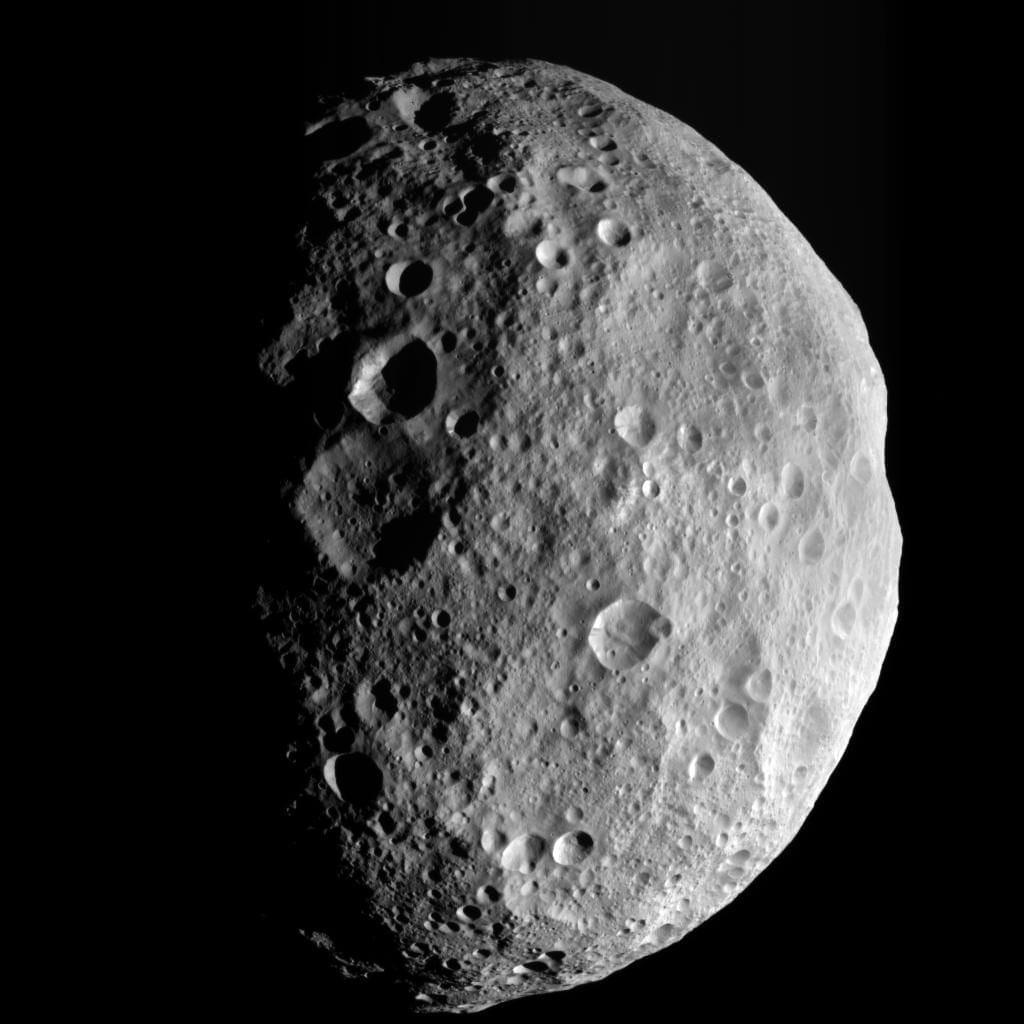
- 1.1What is an asteroid?The leftover rocky and metallic building blocks of the Solar System.
- 1.2The main asteroid beltThe reservoir of most asteroids, between Mars and Jupiter.
- 1.3The largest asteroidsCeres, Vesta, Pallas, and the other giants of the belt.
- 1.4Dwarf planetsThe minor planets big enough to pull themselves round — Ceres, Pluto, Eris, and more.
- 2.1Near-Earth objectsThe Apollo, Aten, Amor, and Atira asteroids whose orbits approach ours.
- 2.2What asteroids are made ofCarbonaceous, silicaceous, and metallic taxonomy from their spectra.
- 2.3Asteroid familiesFragments of shattered parent bodies sharing similar orbits.
- 2.4Trojans and resonancesHow orbital resonances trap asteroids into distinctive populations.
- 3.1Beyond NeptuneThe Kuiper Belt, scattered disc, and the distant detached objects.
- 3.2Exploring asteroidsThe spacecraft that have flown by, orbited, and landed on small bodies.
- 3.3Sample returnBringing pieces of Itokawa, Ryugu, and Bennu back to Earth.
- 3.4Planetary defenseFinding, tracking, and — if ever needed — deflecting hazardous asteroids.
Related entities
- Asteroid
4 Vesta
One of the largest objects in the asteroid belt, visited by NASA's Dawn.
- Asteroid family
Vesta family (Vestoids)
Basaltic fragments blasted from the giant south-polar impact basin of 4 Vesta — the source of the HED meteorites found on Earth.
- Minor-planet group
Main Asteroid Belt
The main asteroid belt between Mars and Jupiter, home to the great majority of known asteroids — from the dwarf planet Ceres down to countless small bodies.
- Near-Earth object class
Apollo asteroids
The largest class of near-Earth asteroids — Earth-crossers with orbits mostly larger than Earth's, named after 1862 Apollo.