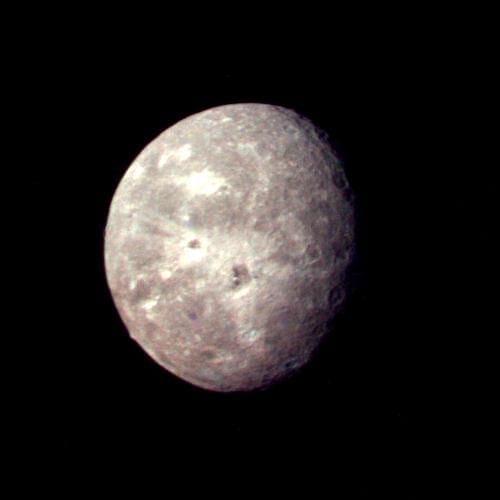
Moon
Oberon
- Type
- Moon
- Diameter
- 1,523 km
NASA/JPL · NASA media (public domain)
Overview
Scientific overview
Oberon is a moon orbiting Uranus.
Physical characteristics
- Mass
- 0.003 ×10²⁴ kg
- Diameter
- 1,523 km
- Radius
- 761.4 km
- Density
- 1.559 g/cm³
- Surface gravity
- 0.33 m/s² · derived
- Escape velocity
- 0.7 km/s · derived
- Albedo
- 0.23
- Magnitude
- 13.7
Derived values
Computed from source-backed inputs via standard formulae — not observations. Every input and constant is traced below.
- Escape velocity0.7 km/sderived
Formula & inputs
Formula: v = √(2GM / r) (v1.0.0, impl v1.0.0)
Inputs:
- mass1e24Kg = 0.00288 ×10²⁴ kg · NASA
- radiusKm = 761.4 km · NASA
Assumptions: G = 6.674e-11 m³ kg⁻¹ s⁻² (CODATA 2018)
Limitations: Assumes a spherical, non-rotating body.; Inputs carry no catalogued uncertainty, so none is propagated.
Uncertainty: not propagated (inputs carry no catalogued uncertainty)
Computed as of 2026-06-29.
- Surface gravity0.33 m/s²derived
Formula & inputs
Formula: g = GM / r² (v1.0.0, impl v1.0.0)
Inputs:
- mass1e24Kg = 0.00288 ×10²⁴ kg · NASA
- radiusKm = 761.4 km · NASA
Assumptions: G = 6.674e-11 m³ kg⁻¹ s⁻² (CODATA 2018)
Limitations: Assumes a spherical, non-rotating body.; Inputs carry no catalogued uncertainty, so none is propagated.
Uncertainty: not propagated (inputs carry no catalogued uncertainty)
Computed as of 2026-06-29.
Scale
Compared to Earth
Oberon is 8.4× smaller than Earth
1,523 km across · Earth is 12,742 km
Observation
How this was captured
- Source
- NASA
- Observation date
- 1996-01-29
Sources
The primary and reference sources this topic draws on.
- NASANational Aeronautics and Space Administration
Mission data, planetary science, space telescopes, and public-domain imagery.
Most NASA-produced imagery is in the public domain; individual items are checked for usage terms before publication.
- NASA JPLJet Propulsion Laboratory / Solar System Dynamics
Orbital data, ephemerides, and small-body parameters for planets, asteroids, and comets.