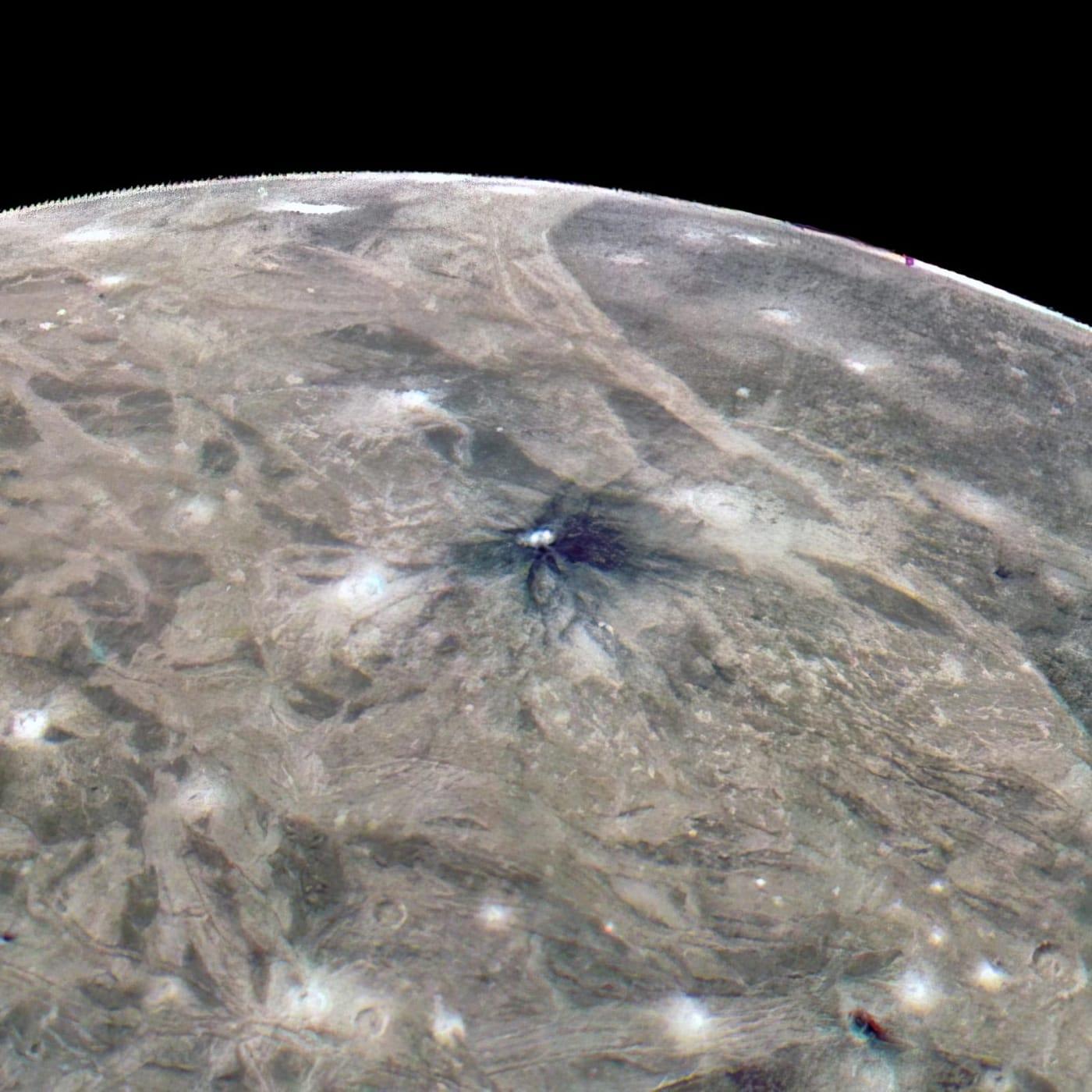
Moon
Ganymede
- Type
- Moon
- Diameter
- 5,262 km
Image data: NASA/JPL-Caltech/SwRI/MSSS Image processing by Thomas Thomopoulos © CC BY · NASA media (public domain)
Overview
Scientific overview
Ganymede is a moon orbiting Jupiter.
Physical characteristics
- Mass
- 0.148 ×10²⁴ kg
- Diameter
- 5,262 km
- Radius
- 2,631.2 km
- Density
- 1.942 g/cm³
- Surface gravity
- 1.43 m/s² · derived
- Escape velocity
- 2.7 km/s · derived
- Albedo
- 0.43
- Magnitude
- 4.61
Derived values
Computed from source-backed inputs via standard formulae — not observations. Every input and constant is traced below.
- Escape velocity2.7 km/sderived
Formula & inputs
Formula: v = √(2GM / r) (v1.0.0, impl v1.0.0)
Inputs:
- mass1e24Kg = 0.14815 ×10²⁴ kg · NASA
- radiusKm = 2631.2 km · NASA
Assumptions: G = 6.674e-11 m³ kg⁻¹ s⁻² (CODATA 2018)
Limitations: Assumes a spherical, non-rotating body.; Inputs carry no catalogued uncertainty, so none is propagated.
Uncertainty: not propagated (inputs carry no catalogued uncertainty)
Computed as of 2026-06-29.
- Surface gravity1.43 m/s²derived
Formula & inputs
Formula: g = GM / r² (v1.0.0, impl v1.0.0)
Inputs:
- mass1e24Kg = 0.14815 ×10²⁴ kg · NASA
- radiusKm = 2631.2 km · NASA
Assumptions: G = 6.674e-11 m³ kg⁻¹ s⁻² (CODATA 2018)
Limitations: Assumes a spherical, non-rotating body.; Inputs carry no catalogued uncertainty, so none is propagated.
Uncertainty: not propagated (inputs carry no catalogued uncertainty)
Computed as of 2026-06-29.
Scale
Compared to Earth
Ganymede is 2.4× smaller than Earth
5,262 km across · Earth is 12,742 km
Gallery
Close-up of Dark Side of Jupiter Moon Ganymede
This image of the dark side of the Jovian moon Ganymede was obtained by the Stellar Reference Unit star camera aboard NASA's Juno spacecraft during its June 7, 2021, flyby of the icy moon.
2021
NASA/JPL-Caltech/SwRI · NASA media (public domain)
Observation
How this was captured
- Source
- NASA
- Observation date
- 2022-02-22
Sources
The primary and reference sources this topic draws on.
- NASANational Aeronautics and Space Administration
Mission data, planetary science, space telescopes, and public-domain imagery.
Most NASA-produced imagery is in the public domain; individual items are checked for usage terms before publication.
- NASA JPLJet Propulsion Laboratory / Solar System Dynamics
Orbital data, ephemerides, and small-body parameters for planets, asteroids, and comets.