Black Holes & Neutron Stars
The end-states of gravity — the geometry of a black hole from its horizon to its singularity, the jets it launches, and the neutron star: a Sun crushed into a city, spinning as a pulsar and holding matter denser than an atomic nucleus. From the physics to the real objects in the sky.
In pictures
Related entities
- Cosmology concept
The Ergosphere
The region just outside the event horizon of a rotating (Kerr) black hole where spacetime itself is dragged around so fast that nothing can stay still relative to the distant stars. Energy can, in principle, be extracted from a black hole's rotation here through the Penrose process. A non-rotating black hole has no ergosphere.
- Black hole
Cygnus X-1 (black hole)
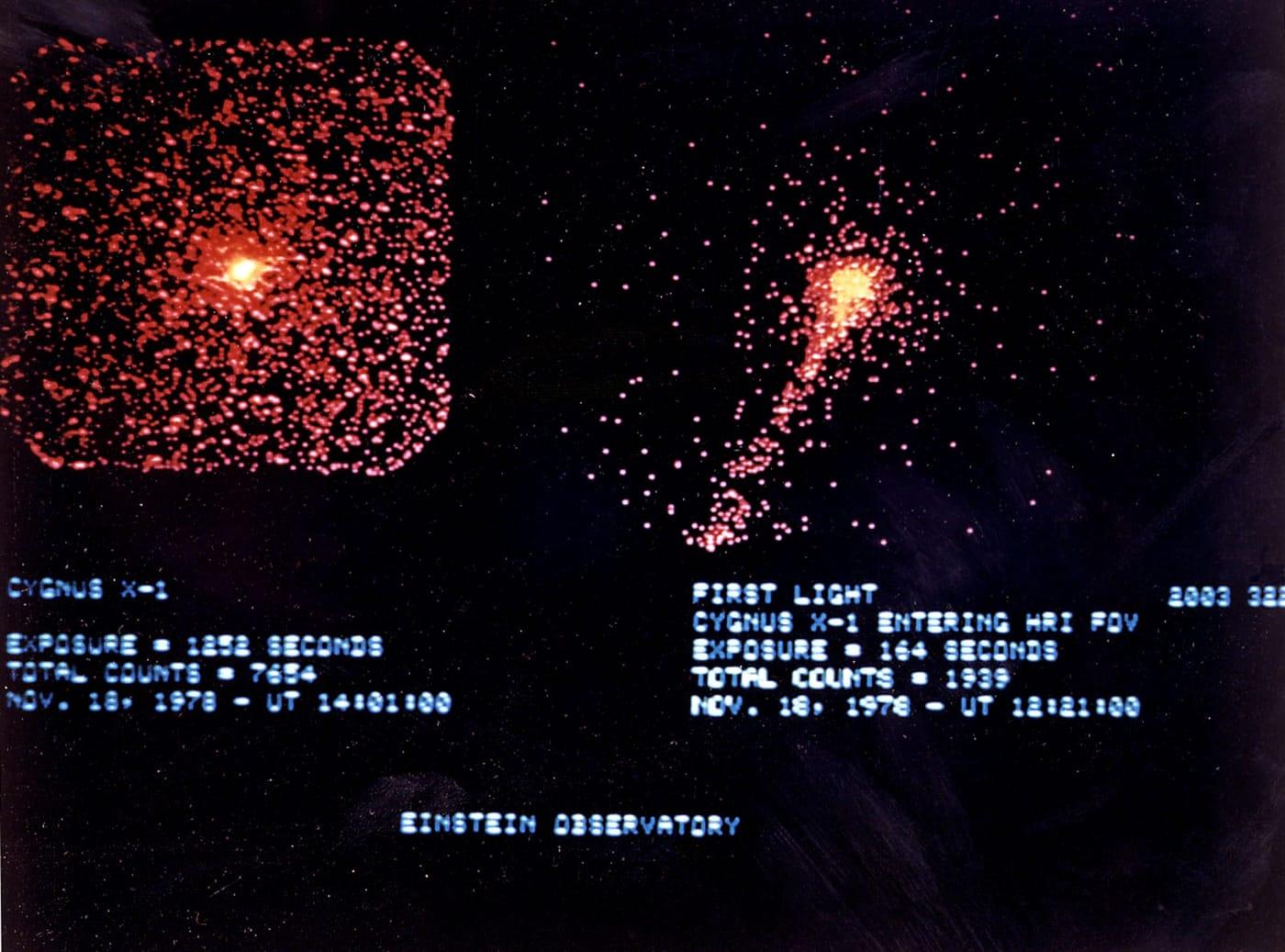
The compact object of Cygnus X-1 — the first widely accepted black hole. A bright X-ray source in Cygnus discovered in 1964, it is a stellar-mass black hole of roughly twenty-one solar masses pulling gas from its blue-supergiant donor star (HD 226868). It was the subject of a famous bet between Stephen Hawking and Kip Thorne, which Hawking conceded in 1990.
- Neutron star
The Crab Pulsar
The young neutron star at the heart of the Crab Nebula, formed in the supernova recorded by observers in 1054. It spins about thirty times a second and is the archetypal rotation-powered pulsar, its wind lighting up the surrounding nebula across the spectrum, from radio to gamma rays.
- Astrophysical object
Pulsar
A rapidly rotating, magnetised neutron star observed as a source of regular pulses of radiation, usually in radio. The first was found in 1967 by Jocelyn Bell Burnell and Antony Hewish; thousands are now known, with periods from milliseconds to seconds. Pulsars are precise cosmic clocks used to test gravity and to search for gravitational waves.