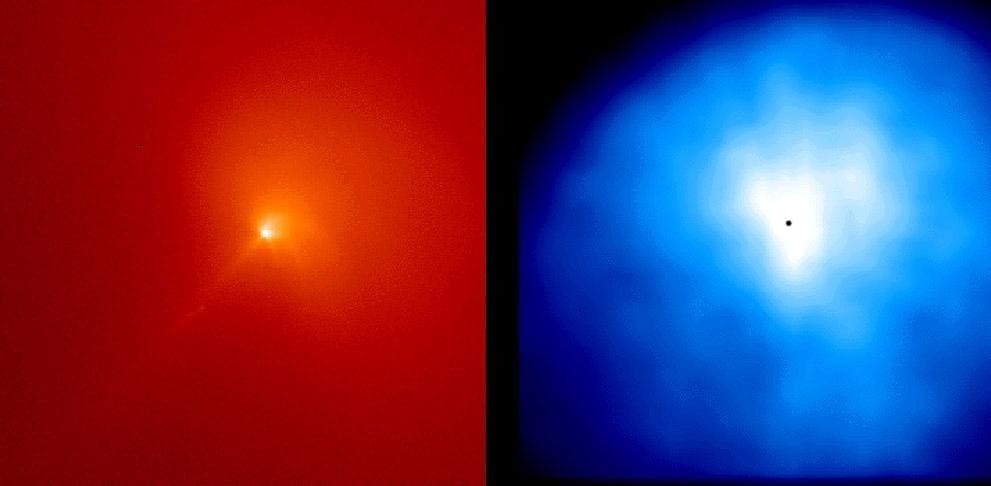
Comet
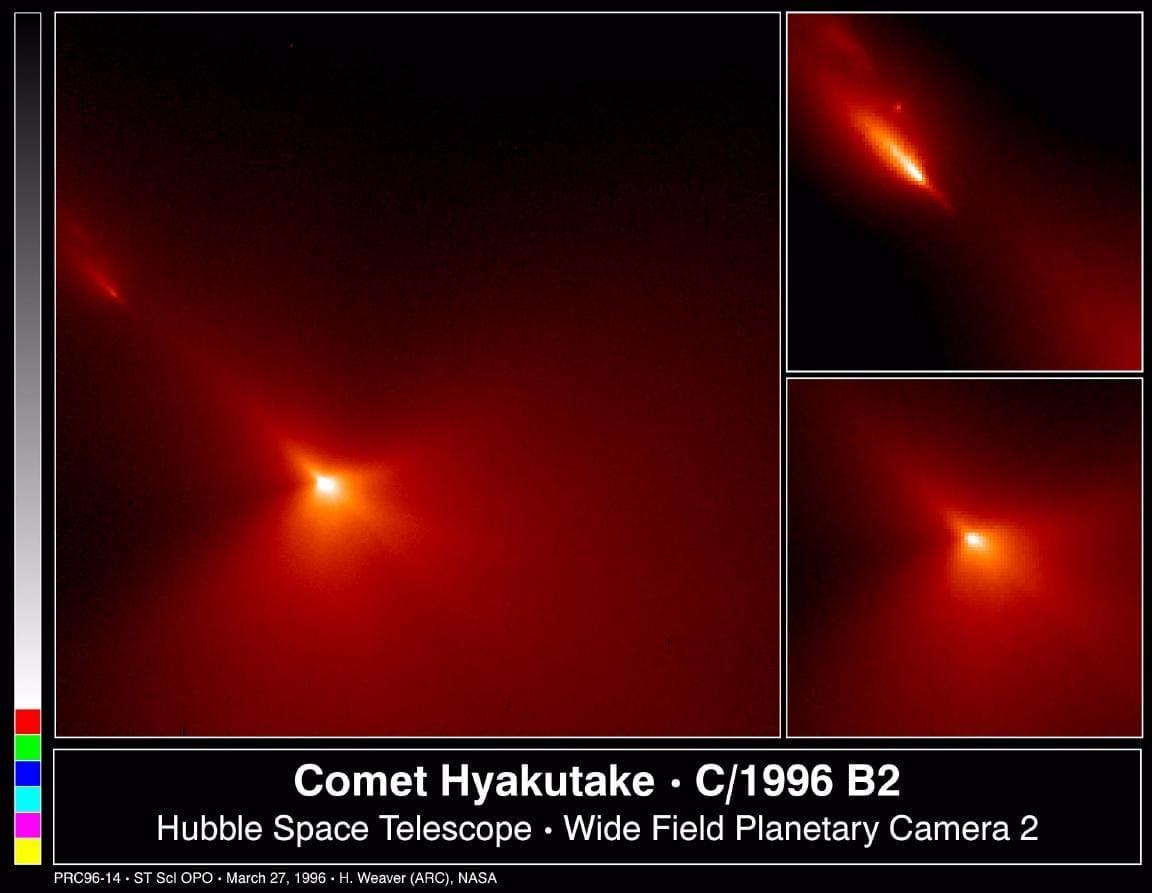
Comet Hyakutake
A comet that passed very close to Earth in 1996.
- Type
- Comet
- Domain
- Scientific connections
- Connections
- 3
NASA/JPL/STScI · NASA media (public domain)
- Type: Comet
- Domain: Scientific connections
Orbit & physical parameters
Osculating orbit and physical parameters from the NASA JPL Small-Body Database · Comet · epoch 1996-03-15 (JD 2450157.5 TDB) · Earth MOID 0.100967 au
| Semi-major axis | 2,125 ± 21.347 au | NASA JPL · calculated |
| Eccentricity | 0.999892 ± 1.0882e-6 | NASA JPL · calculated |
| Perihelion distance | 0.230224 ± 8.9790e-7 au | NASA JPL · calculated |
| Aphelion distance | 4,249 ± 42.693 au | NASA JPL · calculated |
| Inclination | 124.922049 ± 6.3816e-5 deg | NASA JPL · calculated |
| Longitude of ascending node | 188.045132 ± 1.2303e-5 deg | NASA JPL · calculated |
| Argument of perihelion | 130.175121 ± 0.000161 deg | NASA JPL · calculated |
| Orbital period | 3.5774e+7 ± 539,130 d | NASA JPL · calculated |
| Diameter | 4.2 km | NASA JPL · catalogued |
Full field-level provenance
- Semi-major axis: Jet Propulsion Laboratory / Solar System Dynamics · JPL SBDB · orbit.elements · a · JPL orbit determination (least-squares fit to the observation arc) · calculated · JPL solution by Otto Matic, 977 obs · retrieved 2026-07-11
- Eccentricity: Jet Propulsion Laboratory / Solar System Dynamics · JPL SBDB · orbit.elements · e · JPL orbit determination (least-squares fit to the observation arc) · calculated · JPL solution by Otto Matic, 977 obs · retrieved 2026-07-11
- Perihelion distance: Jet Propulsion Laboratory / Solar System Dynamics · JPL SBDB · orbit.elements · q · JPL orbit determination (least-squares fit to the observation arc) · calculated · JPL solution by Otto Matic, 977 obs · retrieved 2026-07-11
- Aphelion distance: Jet Propulsion Laboratory / Solar System Dynamics · JPL SBDB · orbit.elements · ad · JPL orbit determination (least-squares fit to the observation arc) · calculated · JPL solution by Otto Matic, 977 obs · retrieved 2026-07-11
- Inclination: Jet Propulsion Laboratory / Solar System Dynamics · JPL SBDB · orbit.elements · i · JPL orbit determination (least-squares fit to the observation arc) · calculated · JPL solution by Otto Matic, 977 obs · retrieved 2026-07-11
- Longitude of ascending node: Jet Propulsion Laboratory / Solar System Dynamics · JPL SBDB · orbit.elements · om · JPL orbit determination (least-squares fit to the observation arc) · calculated · JPL solution by Otto Matic, 977 obs · retrieved 2026-07-11
- Argument of perihelion: Jet Propulsion Laboratory / Solar System Dynamics · JPL SBDB · orbit.elements · w · JPL orbit determination (least-squares fit to the observation arc) · calculated · JPL solution by Otto Matic, 977 obs · retrieved 2026-07-11
- Orbital period: Jet Propulsion Laboratory / Solar System Dynamics · JPL SBDB · orbit.elements · per · JPL orbit determination (least-squares fit to the observation arc) · calculated · JPL solution by Otto Matic, 977 obs · retrieved 2026-07-11
- Diameter: Jet Propulsion Laboratory / Solar System Dynamics · JPL SBDB · phys_par · phys.diameter · catalogued value · JPL solution by Otto Matic, 977 obs · retrieved 2026-07-11
Orbital elements are a calculated JPL orbit-determination fit, all referred to the single osculating epoch above (solution by Otto Matic); each carries its own uncertainty. Fields the database did not provide are omitted, never invented.
Experience system V6
Comet profile
A trajectory-led view for nucleus, coma, tail, orbit class, and mission or observatory links.
- 01
Observe
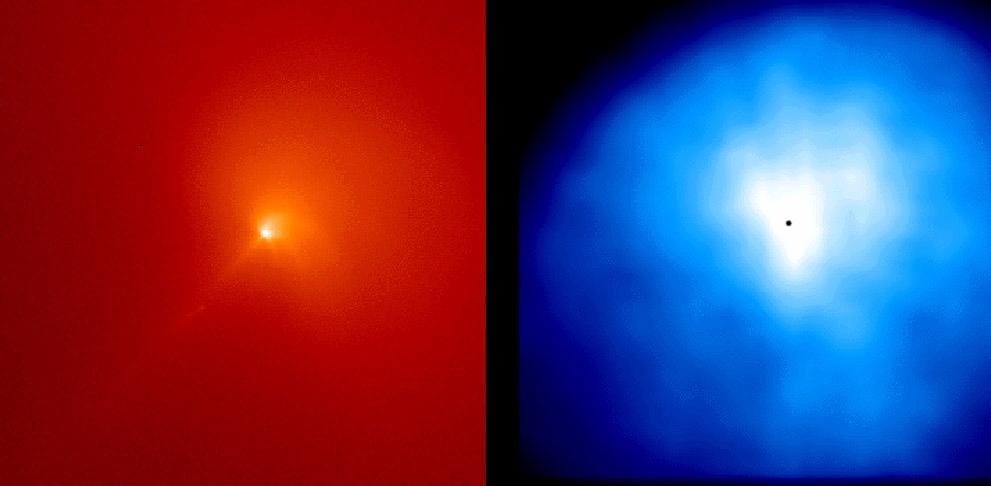
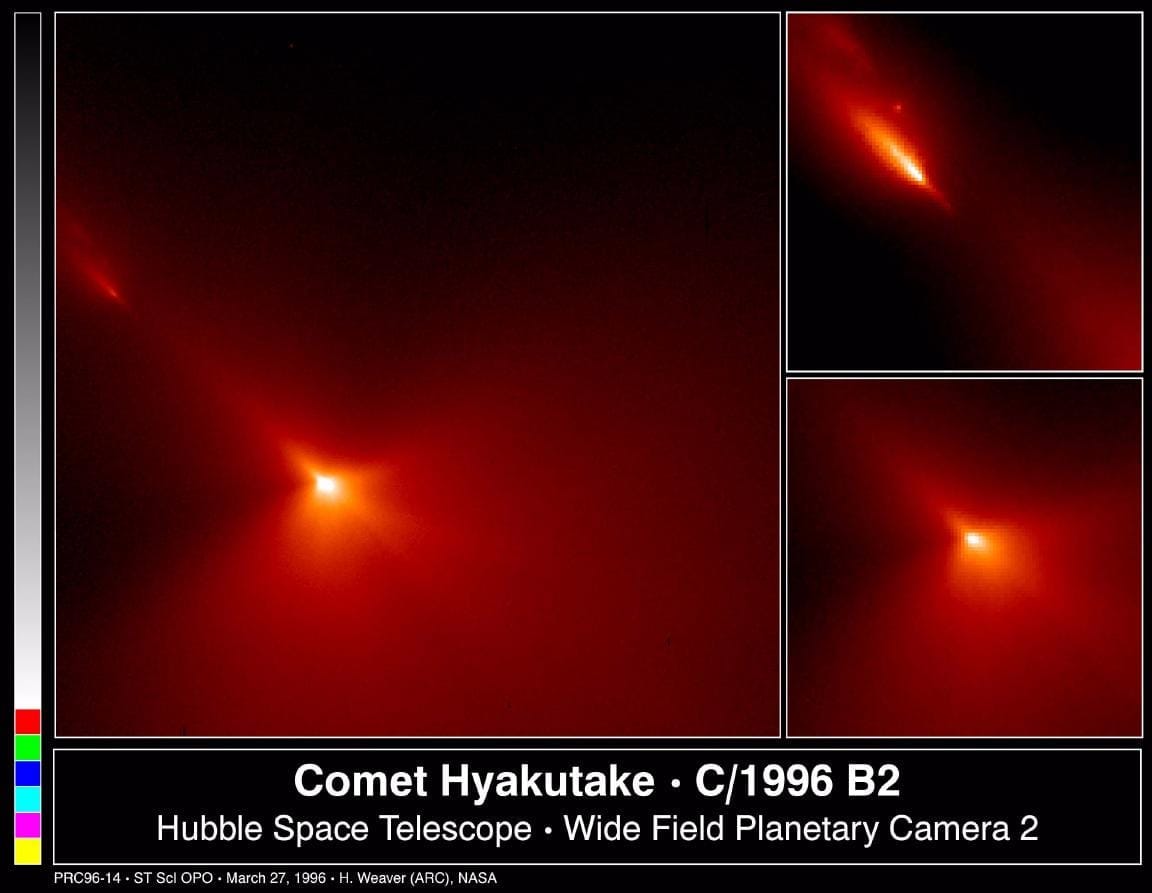
HUBBLE imagery anchors the visual reading with licensed source metadata.
- 02
Measure
Measurement panels use graph coverage, catalog identifiers, and source availability without inventing values.
- 03
Locate
Part of Solar System.
- 04
Connect
3 graph relations shape the knowledge viewport.
- Object type
- Comet
- Graph relations
- 3
- Verified sources
- 1
- Image records
- 2
- Domain
- Scientific connections
- Status
- Graph entity
Scientific map
Orbit context
- Primary orbital anchor
- The Sun
- Measured orbit field
- Orbital distance not recorded in this graph record
Original SVG diagram
Small-body anatomy
- Designation
- C/1996 B2 (Hyakutake)
- Discovery
- 1996
- Eccentricity
- Not recorded
- Inclination
- Not recorded
Visual knowledge graph
Relationships, not isolated facts
This viewport is generated from the Asteria knowledge graph. Science, culture, and interpretive links remain separated by domain so visual context never changes the evidentiary meaning of a relation.
- Member of groupLong-Period Comets
- Source reservoirOort Cloud
- Part ofSolar System
Image provenance
Photography as evidence
Continue the atlas
Curated next objects
Solar System
The Sun and the bodies gravitationally bound to it.
comet classLong-Period Comets
Comets on enormous orbits reaching deep into the outer Solar System, arriving from the Oort cloud after millions of years — the source of most great comets.
small body reservoirOort Cloud
A hypothesised spherical cloud of trillions of icy bodies at the outermost edge of the Sun's gravitational influence — the reservoir from which long-period and Halley-type comets are nudged inward.
cometComet Hale–Bopp
A long-period comet that was widely visible to the naked eye in 1997.
cometComet NEOWISE
A long-period comet discovered in 2020 that became a bright naked-eye object in the Northern Hemisphere sky.
cometMcNaught
The 'Great Comet of 2007', the brightest comet in decades, whose vast fanned dust tail was a spectacular sight from the Southern Hemisphere.
Observation
How this was captured
- Source
- HUBBLE
- Observation date
- 1998-08-02
Data
Scientific data & provenance
Data & provenance
- Stable ID
comet:hyakutake- Type
- Comet
- Domain
- Scientific connections
- Relationships
- 3
- Graph version
- 1.0.0
Dataset membership
Open data
In the graph export: graph.json · graph.jsonld
Planned API: GET /api/v0/entities/comet:hyakutake
Scientific quality
Partial3 of 6 applicable dimensions complete, 1 partial
- Description
- Complete
- Source coverage
- Partial
- Relationship coverage
- Complete
- Review coverage
- None
- Citation coverage
- None
- Image coverage
- Complete
- Timeline coverage
- Not applicable
Scientific entity. Dimensions that cannot apply to this object are excluded rather than counted as gaps. See the evidence framework and authority dashboard.
You might also explore
Sources & references
The primary and reference sources this topic draws on.
- NASANational Aeronautics and Space Administration
Mission data, planetary science, space telescopes, and public-domain imagery.
Most NASA-produced imagery is in the public domain; individual items are checked for usage terms before publication.