Asteroid
99942 Apophis
A near-Earth asteroid studied for its close approaches to Earth.
- Type
- Asteroid
- Domain
- Scientific connections
- Connections
- 5
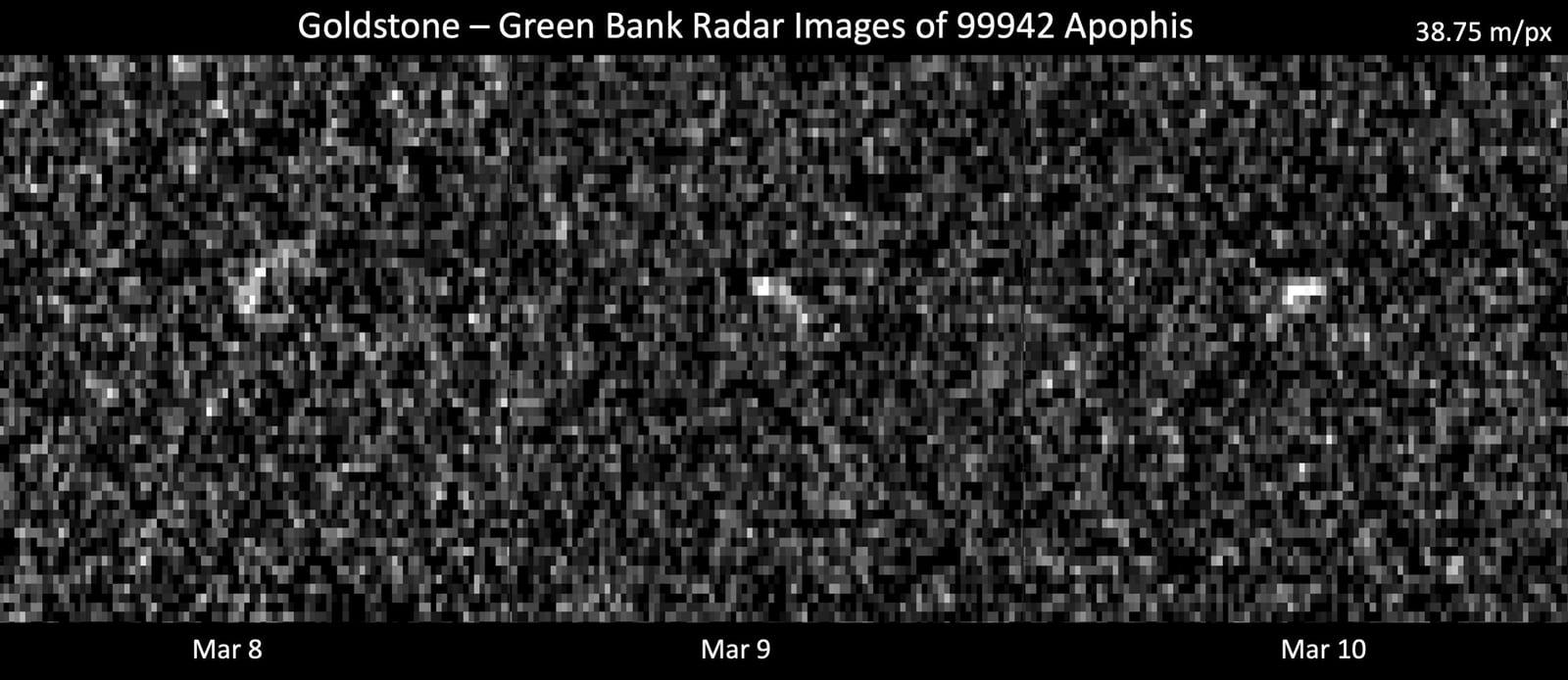
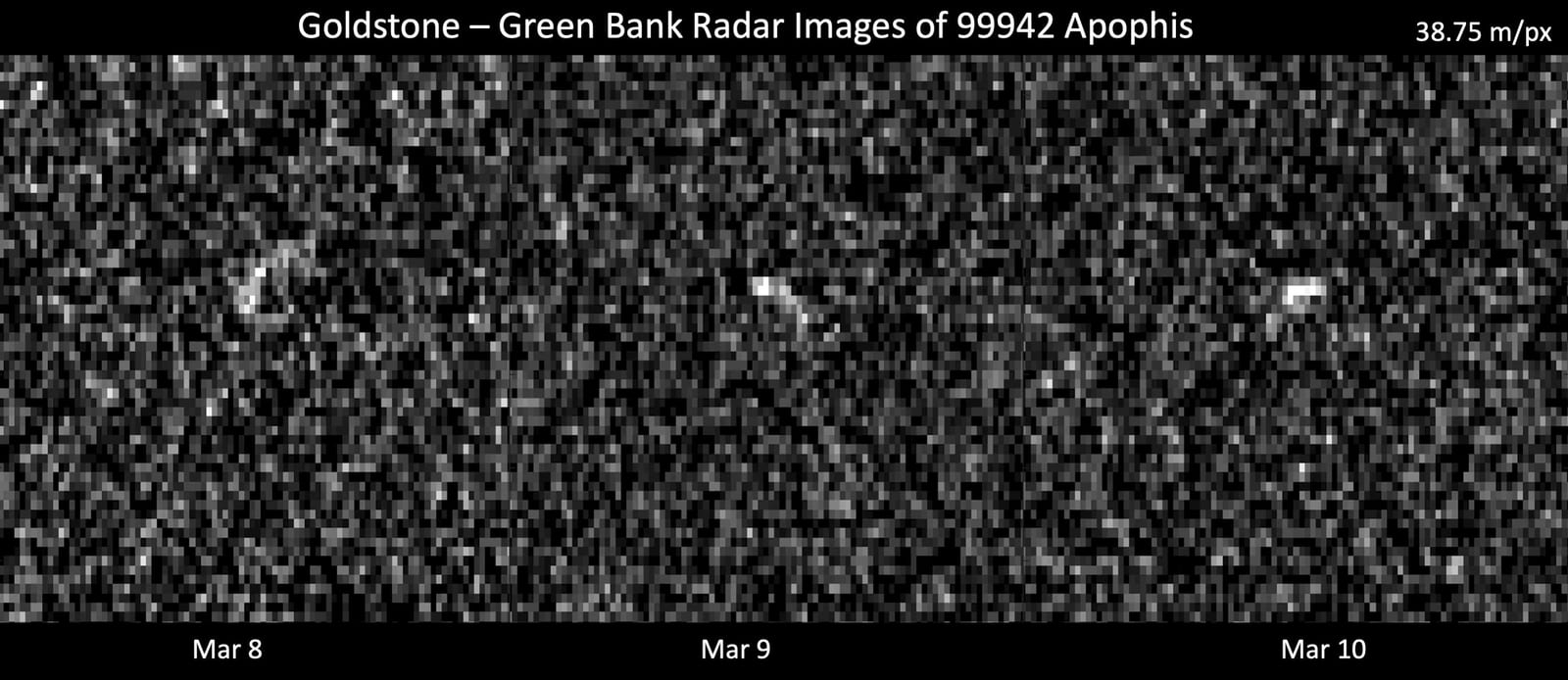
NASA/JPL-Caltech and NSF/AUI/GBO · NASA media (public domain)
- Type: Asteroid
- Domain: Scientific connections
Orbit & physical parameters
Osculating orbit and physical parameters from the NASA JPL Small-Body Database · Aten · near-Earth · potentially hazardous · epoch 2026-06-09 (JD 2461200.5 TDB) · Earth MOID 0.000107917 au
| Semi-major axis | 0.922359 ± 1.5667e-9 au | NASA JPL · calculated |
| Eccentricity | 0.191149 ± 1.8376e-9 | NASA JPL · calculated |
| Perihelion distance | 0.746051 ± 2.8517e-9 au | NASA JPL · calculated |
| Aphelion distance | 1.098667 ± 1.8662e-9 au | NASA JPL · calculated |
| Inclination | 3.340997 ± 9.9030e-8 deg | NASA JPL · calculated |
| Longitude of ascending node | 203.893651 ± 3.0657e-6 deg | NASA JPL · calculated |
| Argument of perihelion | 126.679571 ± 3.3086e-6 deg | NASA JPL · calculated |
| Orbital period | 323.555337 ± 8.2440e-7 d | NASA JPL · calculated |
| Diameter | 0.34 ± 0.04 km | NASA JPL · catalogued |
| Geometric albedo | 0.35 ± 0.1 | NASA JPL · estimated |
| Rotation period | 30.56 ± 0.01 h | NASA JPL · catalogued |
| Absolute magnitude (H) | 19.09 ± 0.19 mag | NASA JPL · catalogued |
Full field-level provenance
- Semi-major axis: Jet Propulsion Laboratory / Solar System Dynamics · JPL SBDB · orbit.elements · a · JPL orbit determination (least-squares fit to the observation arc) · calculated · JPL solution by Davide Farnocchia, 7370 obs · retrieved 2026-07-11
- Eccentricity: Jet Propulsion Laboratory / Solar System Dynamics · JPL SBDB · orbit.elements · e · JPL orbit determination (least-squares fit to the observation arc) · calculated · JPL solution by Davide Farnocchia, 7370 obs · retrieved 2026-07-11
- Perihelion distance: Jet Propulsion Laboratory / Solar System Dynamics · JPL SBDB · orbit.elements · q · JPL orbit determination (least-squares fit to the observation arc) · calculated · JPL solution by Davide Farnocchia, 7370 obs · retrieved 2026-07-11
- Aphelion distance: Jet Propulsion Laboratory / Solar System Dynamics · JPL SBDB · orbit.elements · ad · JPL orbit determination (least-squares fit to the observation arc) · calculated · JPL solution by Davide Farnocchia, 7370 obs · retrieved 2026-07-11
- Inclination: Jet Propulsion Laboratory / Solar System Dynamics · JPL SBDB · orbit.elements · i · JPL orbit determination (least-squares fit to the observation arc) · calculated · JPL solution by Davide Farnocchia, 7370 obs · retrieved 2026-07-11
- Longitude of ascending node: Jet Propulsion Laboratory / Solar System Dynamics · JPL SBDB · orbit.elements · om · JPL orbit determination (least-squares fit to the observation arc) · calculated · JPL solution by Davide Farnocchia, 7370 obs · retrieved 2026-07-11
- Argument of perihelion: Jet Propulsion Laboratory / Solar System Dynamics · JPL SBDB · orbit.elements · w · JPL orbit determination (least-squares fit to the observation arc) · calculated · JPL solution by Davide Farnocchia, 7370 obs · retrieved 2026-07-11
- Orbital period: Jet Propulsion Laboratory / Solar System Dynamics · JPL SBDB · orbit.elements · per · JPL orbit determination (least-squares fit to the observation arc) · calculated · JPL solution by Davide Farnocchia, 7370 obs · retrieved 2026-07-11
- Diameter: Jet Propulsion Laboratory / Solar System Dynamics · JPL SBDB · phys_par · phys.diameter · catalogued value · JPL solution by Davide Farnocchia, 7370 obs · retrieved 2026-07-11
- Geometric albedo: Jet Propulsion Laboratory / Solar System Dynamics · JPL SBDB · phys_par · phys.albedo · Bayesian estimate · JPL solution by Davide Farnocchia, 7370 obs · retrieved 2026-07-11
- Rotation period: Jet Propulsion Laboratory / Solar System Dynamics · JPL SBDB · phys_par · phys.rot_per · catalogued value · JPL solution by Davide Farnocchia, 7370 obs · retrieved 2026-07-11
- Absolute magnitude (H): Jet Propulsion Laboratory / Solar System Dynamics · JPL SBDB · phys_par · phys.H · catalogued value · JPL solution by Davide Farnocchia, 7370 obs · retrieved 2026-07-11
Orbital elements are a calculated JPL orbit-determination fit, all referred to the single osculating epoch above (solution by Davide Farnocchia); each carries its own uncertainty. Fields the database did not provide are omitted, never invented.
Experience system V6
Small-body profile
A catalog-first story for orbit class, discovery, physical parameters, and planetary-defense context when recorded.
- 01
Observe
NASA imagery anchors the visual reading with licensed source metadata.
- 02
Measure
Measurement panels use graph coverage, catalog identifiers, and source availability without inventing values.
- 03
Locate
Part of Solar System.
- 04
Connect
5 graph relations shape the knowledge viewport.
- Object type
- Asteroid
- Graph relations
- 5
- Verified sources
- 1
- Image records
- 1
- Domain
- Scientific connections
- Status
- Graph entity
Scientific map
Orbit context
- Primary orbital anchor
- The Sun
- Measured orbit field
- Orbital distance not recorded in this graph record
Original SVG diagram
Small-body anatomy
- Designation
- (99942) Apophis
- Discovery
- 2004
- Eccentricity
- Not recorded
- Inclination
- Not recorded
Visual knowledge graph
Relationships, not isolated facts
This viewport is generated from the Asteria knowledge graph. Science, culture, and interpretive links remain separated by domain so visual context never changes the evidentiary meaning of a relation.
- Member of groupAten asteroids
- Associated withImpact Monitoring
- Associated withRisk Communication
- Part ofSolar System
- Associated withThe Torino Scale
Image provenance
Photography as evidence
Continue the atlas
Curated next objects
Solar System
The Sun and the bodies gravitationally bound to it.
near earth objectAten asteroids
Near-Earth asteroids with orbits mostly inside Earth's but reaching out to cross it, named after 2062 Aten.
defense stageImpact Monitoring
Automatic systems at CNEOS and ESA continuously propagate every known orbit forward for a century or more, flagging any that could approach Earth. Apophis was tracked this way until observations ruled out an impact for the next century.
defense stageRisk Communication
Explaining a risk to decision-makers and the public accurately and without alarm — including retracting a warning when better data clears an object, as happened with Apophis. Clear communication is itself part of planetary defence.
risk scaleThe Torino Scale
A 0–10 scale, like a hazard traffic light, for communicating the risk of a near-Earth object to the public — combining impact probability and energy into a single colour-coded number. Apophis briefly reached level 4, the highest ever, before further observations returned it to zero.
organizationCNEOS
NASA's Center for Near-Earth Object Studies, at the Jet Propulsion Laboratory, which computes near-Earth-object orbits and impact risk and maintains the public fireball database. Its reported velocity for the 2014-01-08 bolide is the basis of a debated — and unconfirmed — claim of an interstellar meteor.
Observation
How this was captured
- Source
- NASA
- Observation date
- 2021-03-26
Data
Scientific data & provenance
Data & provenance
- Stable ID
asteroid:apophis- Type
- Asteroid
- Domain
- Scientific connections
- Relationships
- 5
- Graph version
- 1.0.0
Dataset membership
Open data
In the graph export: graph.json · graph.jsonld
Planned API: GET /api/v0/entities/asteroid:apophis
Scientific quality
Partial3 of 6 applicable dimensions complete, 1 partial
- Description
- Complete
- Source coverage
- Partial
- Relationship coverage
- Complete
- Review coverage
- None
- Citation coverage
- None
- Image coverage
- Complete
- Timeline coverage
- Not applicable
Scientific entity. Dimensions that cannot apply to this object are excluded rather than counted as gaps. See the evidence framework and authority dashboard.
You might also explore
Sources & references
The primary and reference sources this topic draws on.
- NASA JPLJet Propulsion Laboratory / Solar System Dynamics
Orbital data, ephemerides, and small-body parameters for planets, asteroids, and comets.